
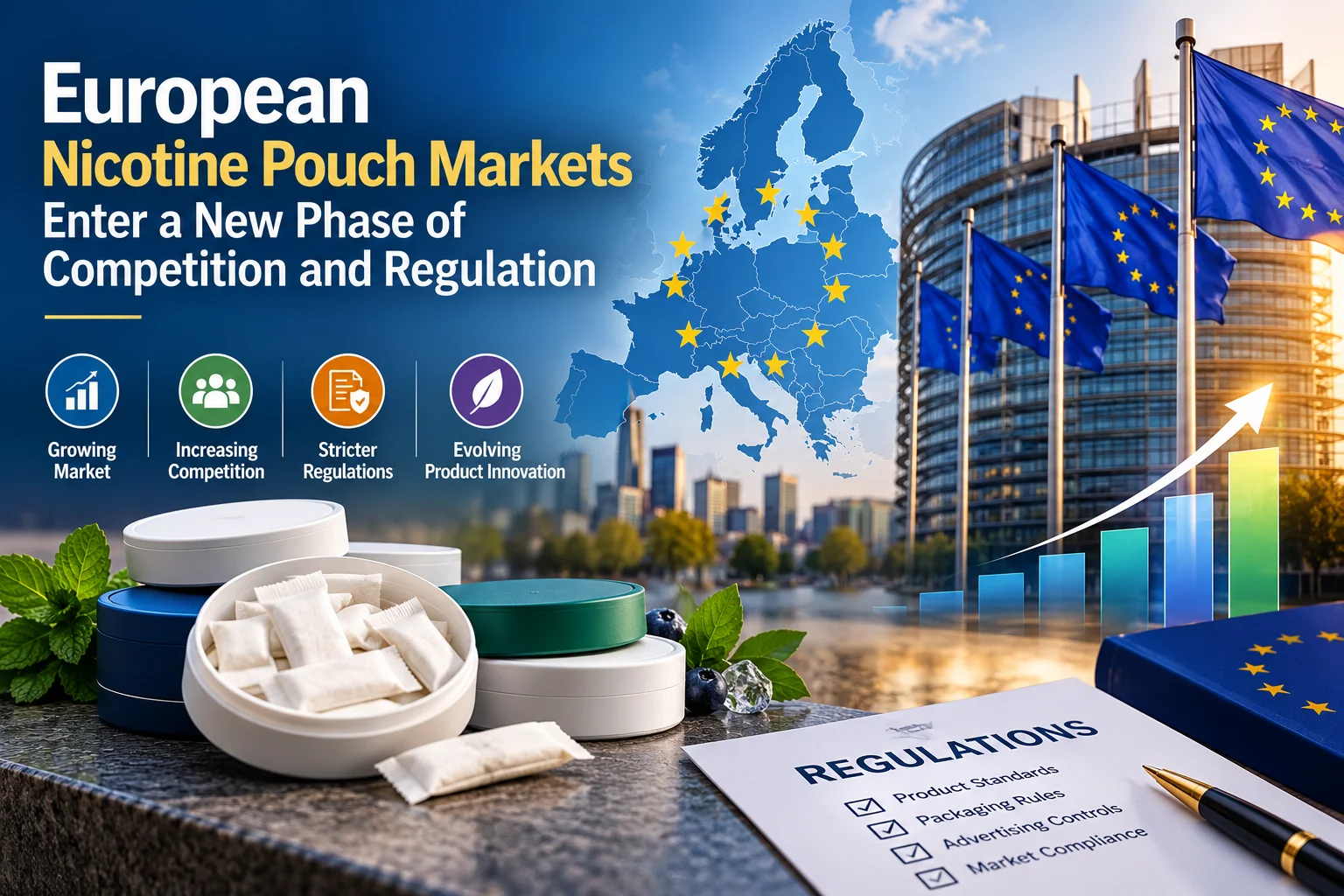
European Nicotine Pouch Markets Enter a New Phase of Competition and Regulation
European nicotine pouch markets are entering a new phase as manufacturers compete for market share while regulators across Europe move toward tighter and more consistent rules for the growing category.
Nicotine pouches have developed from a relatively small emerging category into an increasingly significant part of Europe’s wider nicotine market. At the same time, the regulatory environment remains fragmented, with individual countries adopting different approaches to product classification, nicotine strength, packaging, flavours, advertising and sales.
This combination of growing competition and regulatory change is becoming an important consideration for manufacturers, suppliers, distributors and B2B buyers operating across European markets.
European Nicotine Pouch Markets Continue to Expand
The European nicotine pouch market has recorded substantial growth in recent years.
According to the European Commission’s 2026 evaluation of the EU tobacco-control framework, the value of the EU nicotine pouch market increased from approximately €60.8 million in 2018 to €1.09 billion in 2023. The Commission also reported that nicotine pouch sales value increased by around 1,697% between 2018 and 2023.
The growth has been concentrated in several European markets. In 2023, Sweden and Denmark together accounted for around two-thirds of EU nicotine pouch sales, followed by Austria and Czechia.
The figures show why nicotine pouches have become an increasingly important category for manufacturers and investors.
Competition Between Nicotine Pouch Manufacturers Is Increasing
As the category becomes more established, competition between manufacturers is also intensifying.
Companies are competing through different product formats, nicotine strengths, pouch characteristics, flavour profiles, packaging concepts and distribution networks.
Recent developments from major tobacco companies demonstrate the commercial importance of the category. British American Tobacco said in September 2026 that it expects its nicotine pouch industry revenues to triple and identified nicotine pouches as a major driver of growth in its smoking-alternatives business.
For manufacturers, this means the European market is increasingly moving beyond simple category expansion toward brand competition, product differentiation and manufacturing consistency.
Product Innovation Becomes a Key Competitive Factor
As more companies enter or expand within the category, product development is becoming increasingly important.
Manufacturers are evaluating factors such as:
- Nicotine strength
- Pouch size
- Moisture characteristics
- Nicotine release
- Flavour systems
- Pouch material
- Packaging formats
- Product consistency
However, product innovation must increasingly be considered alongside regulatory requirements.
A formulation or packaging concept developed for one European market may not necessarily meet the requirements of another country.
This makes market-specific product development increasingly important for companies planning cross-border expansion.
European Nicotine Pouch Regulations Remain Fragmented
One of the biggest challenges facing European nicotine pouch markets is the lack of a single, fully harmonised regulatory framework.
The European Commission’s 2026 evaluation states that nicotine pouches are currently outside the EU tobacco-control framework and that Member States have adopted different approaches. These range from complete bans and nicotine-content limits to age restrictions, packaging and labelling requirements, notification systems and advertising restrictions.
This means that manufacturers cannot assume that a product permitted in one European market will automatically be permitted in another.
For companies selling across multiple countries, regulatory mapping has therefore become an important part of market-entry planning.
Why Regulatory Fragmentation Matters for B2B Buyers
Different national requirements can increase complexity for manufacturers and distributors.
A company entering several European markets may need to evaluate:
- Product classification
- Maximum nicotine concentration
- Ingredient requirements
- Flavour restrictions
- Packaging specifications
- Health warnings
- Advertising rules
- Minimum sales age
- Retail requirements
- Online sales restrictions
- Product notification procedures
The European Commission has specifically identified regulatory fragmentation as a source of market barriers and legal uncertainty.
For B2B buyers, this makes supplier documentation and product traceability increasingly important.
EU-Level Regulation Could Reshape the Market
The regulatory landscape could change further at EU level.
The European Commission adopted a proposal on 16 July 2025 to recast the Tobacco Taxation Directive. According to the Commission’s 2026 evaluation, the proposal would extend the scope of the framework to explicitly include nicotine pouches and other nicotine products.
This is important because nicotine pouches currently sit outside the EU tobacco-control framework.
An EU-level framework could potentially reduce some differences between national markets, although the final regulatory outcome will depend on the legislative process and the measures ultimately adopted.
Businesses should therefore distinguish between current national rules and proposed future EU measures when planning market entry.
Flavours and Packaging Are Under Increasing Attention
Flavours and packaging have become important areas of regulatory discussion.
European regulators are examining how product presentation, flavouring and marketing can influence product appeal and consumer behaviour.
The European Commission’s evaluation notes differences between Member States in areas including flavours, packaging and marketing of novel nicotine products.
For manufacturers, this creates a need to develop flexible packaging and product strategies that can accommodate different market requirements.
Companies may also need to maintain separate packaging or labelling configurations for different European markets.
Nicotine Strength Is Another Important Market Variable
Nicotine concentration is another area where European rules can differ.
Some countries have introduced maximum nicotine-content limits, while others have taken different approaches to classification or market access.
This creates additional challenges for manufacturers developing a single product portfolio for multiple markets.
A product-development strategy may therefore need to include different nicotine strengths or formulations depending on the destination market.
For B2B raw-material buyers, consistent nicotine specifications become particularly important when manufacturing products to different market requirements.
Quality and Raw-Material Consistency Gain Importance
As competition increases, manufacturers need to maintain consistent product specifications.
For nicotine pouch manufacturers, the quality of the underlying nicotine raw material can be an important part of formulation control.
Parameters such as assay, related alkaloids, residual solvents, moisture and other specification requirements may need to be controlled according to the intended application and applicable quality standards.
Buyers sourcing high-purity nicotine can review 99.9% pure nicotine specifications, batch documentation and available quality information before qualifying a supplier.
For manufacturers, reliable batch-to-batch consistency can help reduce unnecessary formulation adjustments and support internal quality-control processes.
European Market Growth Is Happening Alongside Greater Regulatory Scrutiny
The commercial expansion of nicotine pouches is occurring at the same time as increased regulatory attention.
The World Health Organization reported in May 2026 that global retail sales of nicotine pouches exceeded 23 billion units in 2024, representing more than 50% growth from the previous year. WHO also estimated the global nicotine pouch market at nearly US$7 billion in 2025.
This growth has prompted greater attention from regulators and public-health organisations, particularly around youth access, product appeal, flavours and digital marketing.
For European manufacturers, regulatory compliance is therefore becoming a competitive consideration rather than simply a legal requirement.
What This Means for European Nicotine Pouch Manufacturers
Manufacturers planning to expand across Europe may need to adopt a more structured market-by-market approach.
Before launching a nicotine pouch product, companies should assess:
- Product classification
- Permitted nicotine strength
- Ingredient requirements
- Flavour restrictions
- Packaging requirements
- Labelling and warnings
- Advertising restrictions
- Minimum-age requirements
- Retail and online sales rules
- Product notification requirements
This approach can help manufacturers identify differences before committing to large-scale production or packaging.
Supplier Qualification Becomes More Important
The changing European regulatory environment also increases the importance of supplier qualification.
B2B buyers should consider whether a nicotine supplier can provide:
- Batch-specific Certificate of Analysis
- Product specification sheet
- Safety Data Sheet
- Traceability information
- Consistent assay
- Relevant quality documentation
- Export documentation
- Market-specific support where applicable
McCoy NIC supplies nicotine raw materials to qualified B2B manufacturers, with product specifications and batch documentation available according to product and order requirements.
Buyers can also review nicotine salts when evaluating raw-material options for formulations where salt-based nicotine is appropriate.
A More Competitive and More Regulated European Market
The next phase of the European nicotine pouch industry is likely to be shaped by two parallel developments: stronger competition and increasing regulatory oversight.
Manufacturers are investing in product development, production capacity and international distribution while governments and EU institutions continue examining how emerging nicotine products should be regulated.
For businesses operating across Europe, success will increasingly depend on the ability to combine product quality and innovation with accurate market-specific compliance.