Inside a B2B Supplier’s Enquiry-to-Quotation Workflow
The B2B enquiry to quotation workflow is an important part of business-to-business procurement. It connects a buyer’s initial product enquiry with the supplier’s review of requirements, preparation of commercial terms, and submission of a quotation. A clear workflow helps both parties understand product requirements, pricing, documentation, and expected delivery timelines before moving toward an order.
For ingredient suppliers, the process may also involve technical specifications, quality documentation, regulatory considerations, and shipping requirements. Organising these steps can reduce avoidable communication gaps and help buyers make informed purchasing decisions.
What Is an Enquiry-to-Quotation Workflow?
An enquiry-to-quotation workflow is the sequence of activities a supplier follows after receiving a potential buyer’s request for product or pricing information.
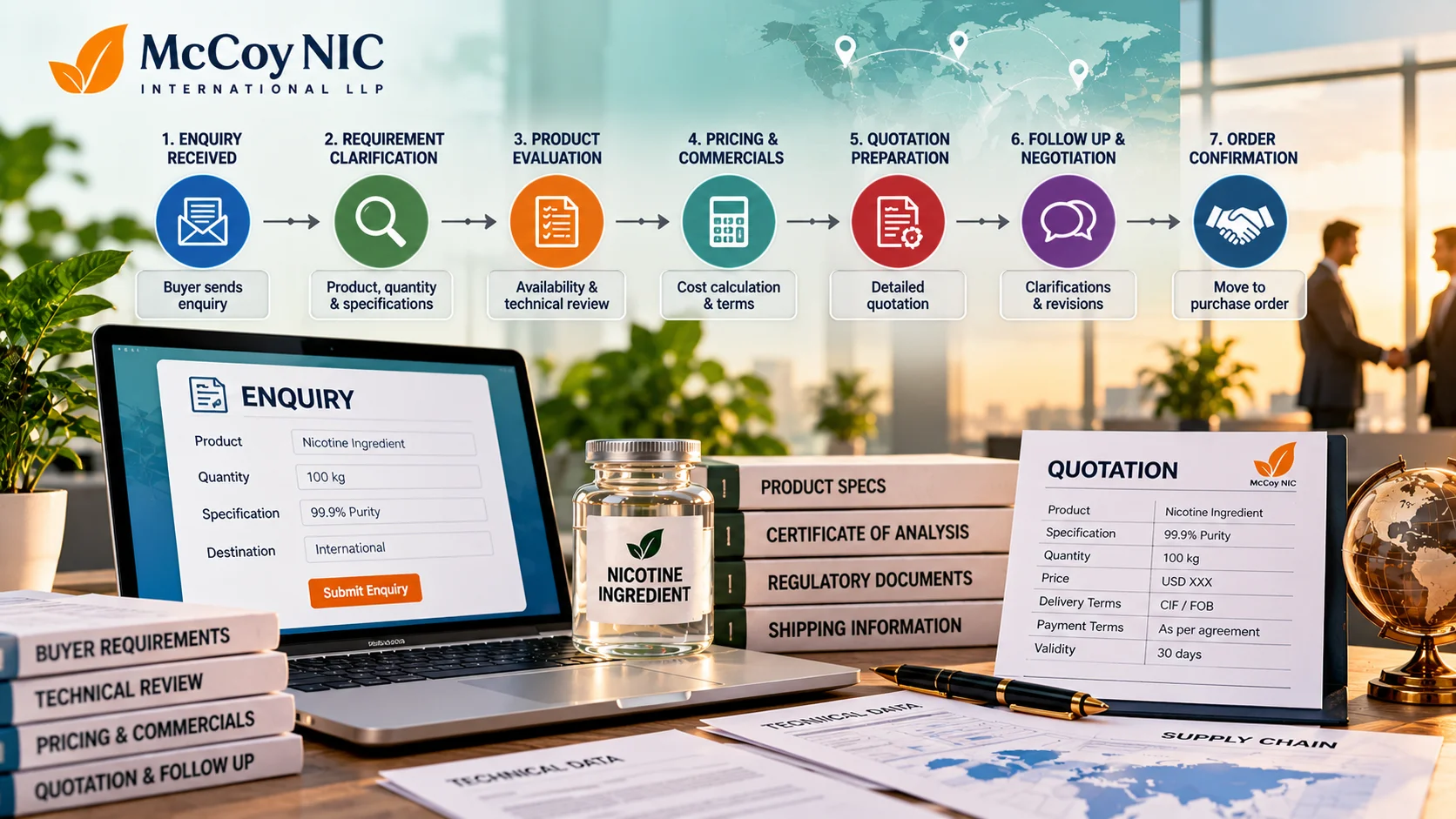
The process typically includes enquiry registration, requirement clarification, product and availability checks, cost calculation, quotation preparation, internal review, and buyer follow-up. The exact steps depend on the supplier’s business model, product category, and customer requirements.
A quotation is a commercial offer, not necessarily a confirmed order. The buyer may request revisions, compare suppliers, complete internal approvals, or decide not to proceed.
Step 1: Receive and Record the Buyer’s Enquiry
The workflow begins when a potential buyer contacts the supplier through a website form, email, telephone call, B2B portal, or another business channel.
The supplier should record the enquiry in a structured system so that the request can be reviewed and tracked.
Useful information may include:
- Buyer’s company name and contact details
- Product name and required specification
- Requested quantity and expected order frequency
- Intended application, where relevant
- Delivery destination
- Target delivery date
- Required technical or commercial documents
Recording these details helps prevent enquiries from being overlooked and gives the sales team a consistent starting point.
Step 2: Clarify Product and Commercial Requirements
An enquiry may not contain enough information to prepare an accurate quotation. The supplier may need to clarify the required grade, specification, quantity, packaging, delivery destination, or other order conditions.
For specialised ingredients, product identity and intended application can be particularly important. The supplier should confirm that the requested product matches its available offering rather than making assumptions based on a general product name.
If essential details are missing, asking focused questions early can prevent repeated revisions later in the process.
Step 3: Review Product Availability and Technical Information
Before quoting, the supplier should establish whether the requested product and specification can be offered within the buyer’s expected timeline.
Depending on the product, this review may involve inventory availability, production lead time, minimum order quantity, packaging options, and relevant technical documentation.
For nicotine-related enquiries, buyers may need to review product specifications, applicable quality information, and safety documentation. Suppliers should provide only verified information and confirm which documents are available for the specific product or batch.
Relevant McCoy NIC resources include:
- Pure Nicotine 99.9%
- Tobacco-Derived Nicotine
- Synthetic Nicotine
- Certificates and Quality Information
These pages help buyers explore product and quality information relevant to their enquiries.
Step 4: Calculate the Commercial Offer
Once the requirements are sufficiently clear, the supplier can prepare the commercial offer.
Pricing may depend on order quantity, product specification, packaging, production costs, logistics, payment terms, and the delivery arrangement. The supplier should use consistent assumptions when calculating the quoted price.
Where relevant, the commercial review may include:
- Unit price and total order value
- Currency and quotation validity
- Minimum order quantity
- Packaging and handling charges
- Freight and insurance arrangements
- Applicable taxes or other charges
- Payment terms
- Estimated dispatch or delivery timeline
The quotation should distinguish confirmed costs from estimates and clearly state any exclusions or conditions. This allows buyers to compare offers on a more consistent basis.
Step 5: Prepare and Review the Quotation
A professional quotation should present the offer in a clear, organised format. Before sending it, the supplier should verify that the commercial details match the buyer’s request.
A typical quotation includes:
- Supplier and buyer details
- Quotation reference number and date
- Product description and specification
- Quantity, unit price, and total value
- Currency and applicable commercial terms
- Delivery or dispatch estimate
- Payment terms and quotation validity
- Relevant conditions and exclusions
An internal review can help identify incorrect quantities, inconsistent product descriptions, calculation errors, or unclear delivery commitments.
The supplier should also ensure that the quotation does not promise a specification, delivery date, certification, or regulatory status that has not been verified.
Step 6: Send the Quotation and Track the Response
After the quotation is approved, the supplier sends it to the buyer using the agreed communication channel.
The supplier should record the date of submission, quotation reference, quoted value, validity period, and any next action. A follow-up date can be set according to the buyer’s stated decision timeline.
If the buyer requests clarification, the supplier should document the response and issue a revised quotation when necessary. Maintaining version control helps both parties identify which offer is current.
For relevant nicotine product enquiries, buyers can visit the McCoy NIC Request CoA and Price page.
Step 7: Handle Negotiations and Additional Questions
A buyer may ask for a different quantity, revised pricing, alternative packaging, additional documents, or a change in delivery arrangements.
The supplier should evaluate each request before confirming a change. A lower price, for example, may depend on order volume, commercial conditions, or other factors that affect the offer.
Technical or quality questions should be routed to the appropriate team where necessary. Regulatory and import-related questions should be checked against the relevant product and destination requirements.
Clear written communication helps avoid misunderstandings and creates a record of agreed changes.
Step 8: Move from Quotation to Confirmed Order
If the buyer accepts the quotation, the supplier should confirm the order details before proceeding.
This may involve a purchase order, written acceptance, final specification confirmation, payment arrangements, and agreement on delivery conditions. The supplier should verify that the accepted terms match the latest quotation.
An enquiry or verbal indication of interest should not be treated as a confirmed order unless the applicable acceptance requirements have been met.
Once the order is confirmed, responsibility may pass to order processing, production, quality, logistics, and finance teams according to the supplier’s internal procedures.
Common Problems in the Enquiry-to-Quotation Process
Several issues can make the workflow slower or less reliable:
Incomplete buyer requirements: Missing specifications or quantities can lead to repeated clarification.
Slow internal coordination: Delays in checking availability, costs, or technical information can postpone the quotation.
Inconsistent product descriptions: Differences between the enquiry, quotation, and technical documents may create confusion.
Unclear commercial terms: Missing validity dates, delivery conditions, or payment terms can lead to further negotiations.
Poor follow-up tracking: Without a clear record of quotation status and next actions, opportunities may be overlooked.
Unrealistic delivery commitments: Quoting a timeline without confirming availability and logistics can create problems after order acceptance.
A structured workflow helps suppliers identify these issues earlier and assign responsibility for resolving them.
How Suppliers Can Improve Their Workflow
B2B suppliers can improve enquiry handling without making the process unnecessarily complicated.
- Use a central register or CRM to record enquiries and quotation status.
- Create standard enquiry forms to collect essential buyer requirements.
- Use consistent quotation templates and approval checks.
- Maintain accessible, up-to-date product and quality information.
- Assign responsibility for technical questions and commercial approvals.
- Set follow-up reminders based on buyer timelines.
- Track quotation turnaround time, revision frequency, and conversion rates.
- Review recurring delays and improve the relevant process step.
These practices can improve visibility across sales and operations while helping buyers receive clearer, more consistent responses.