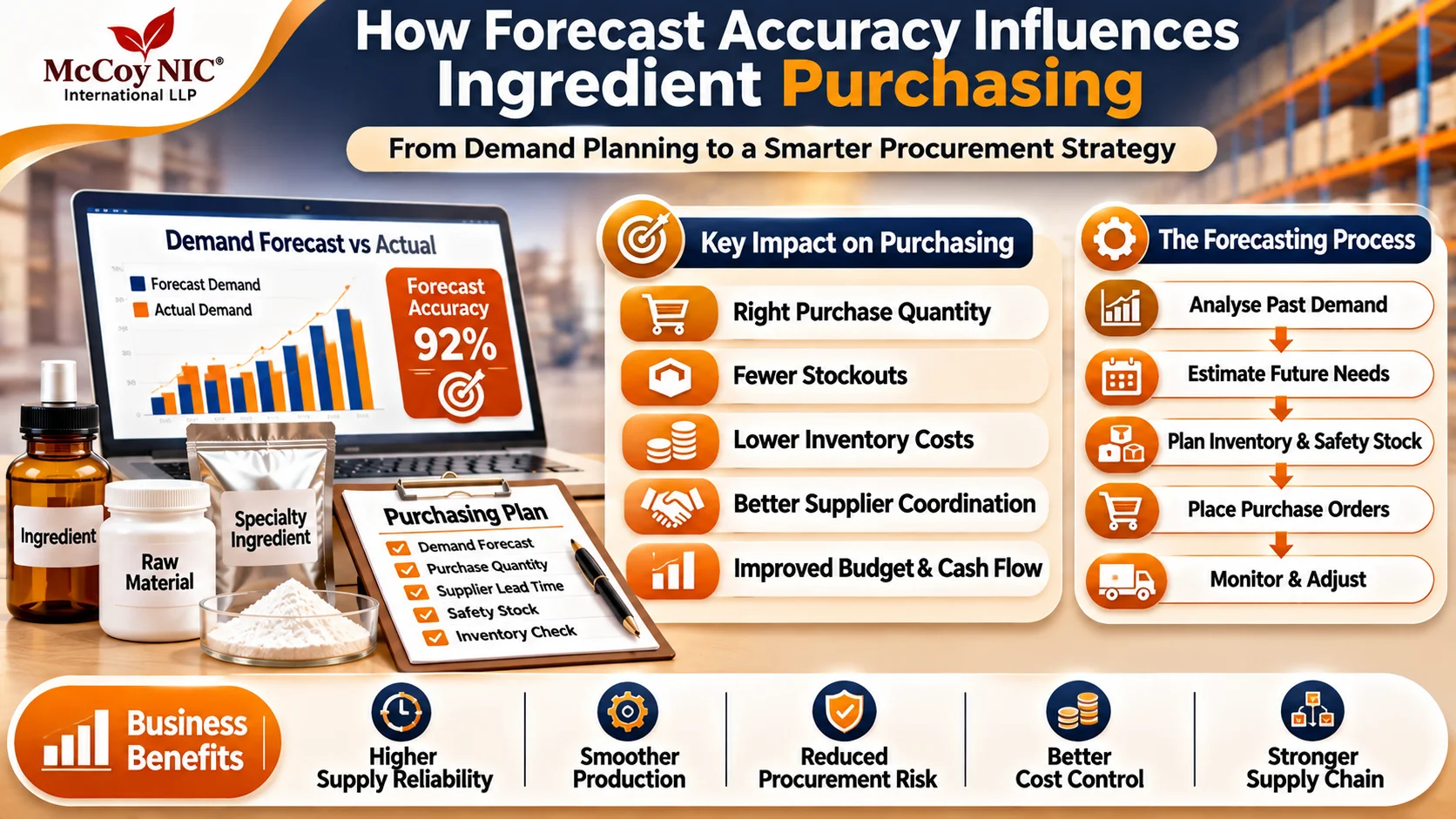
How Forecast Accuracy Influences Ingredient Purchasing
Ingredient purchasing is an important part of business operations, particularly for manufacturers that depend on a consistent supply of raw materials. Buying too much can increase storage costs and tie up working capital, while purchasing too little can interrupt production and delay customer orders.
This is where forecast accuracy in ingredient purchasing becomes important. Accurate demand forecasts help businesses estimate future ingredient requirements, plan purchase quantities, coordinate with suppliers and maintain suitable inventory levels.
For companies sourcing specialty chemicals, pharmaceutical ingredients and nicotine-related materials, effective forecasting can also support better coordination between purchasing, production, quality and logistics teams.
What Is Forecast Accuracy?
Forecast accuracy measures how closely predicted demand matches actual demand over a specific period.
For example, if a manufacturer forecasts that it will require 1,000 kg of an ingredient in a month but actually uses 900 kg, the forecast has an error of 100 kg.
Forecast accuracy helps procurement teams understand whether their purchasing plans are based on realistic demand estimates or inaccurate assumptions.
A common measurement is Mean Absolute Percentage Error (MAPE), which compares the absolute difference between forecast and actual demand.
MAPE Formula:
MAPE = Average of [|Actual Demand − Forecast Demand| ÷ Actual Demand] × 100
A lower MAPE generally indicates a smaller forecasting error. Businesses should select a measurement method appropriate to their data and avoid relying on a single performance figure without considering product and demand patterns.
Why Forecast Accuracy Matters in Ingredient Purchasing
Ingredient purchasing decisions affect production schedules, inventory levels, supplier relationships and overall operating costs.
Here are some important ways forecast accuracy influences procurement.
1. Helps Determine the Right Purchase Quantity
Accurate forecasts help purchasing teams estimate how much material will be required during a particular period.
When demand is overestimated, businesses may purchase excess ingredients that remain unused for longer than expected. Underestimating demand can result in insufficient stock and urgent purchasing requirements.
By comparing historical consumption, confirmed orders and expected production requirements, companies can prepare more realistic purchasing plans.
2. Reduces the Risk of Stockouts
A stockout occurs when the required material is unavailable at the time it is needed.
For manufacturers dependent on specific ingredients, shortages can delay production schedules and affect customer commitments.
Forecast accuracy helps businesses identify future material requirements early and arrange procurement before existing inventory becomes insufficient.
However, forecasts should also account for supplier reliability, replenishment lead times and unexpected changes in demand.
3. Helps Control Excess Inventory
Purchasing more material than necessary can increase inventory carrying costs.
These may include:
- Warehouse and storage expenses
- Insurance and handling charges
- Working capital tied up in stock
- Quality monitoring and inventory management
- Expiry, deterioration or obsolescence risks, where applicable
A more accurate forecast helps procurement teams balance material availability with the cost of maintaining excess inventory.
4. Improves Supplier Coordination
Suppliers need reasonable visibility into expected purchasing requirements to plan their own production, inventory and dispatch schedules.
Sharing rolling demand forecasts with suppliers can help them understand potential order volumes and expected delivery timelines.
Regular communication also allows purchasing teams to discuss capacity limitations, material availability and changes in lead times before they affect production.
5. Supports Better Budget and Cash-Flow Planning
Ingredient purchases can represent a significant operating expense.
When demand forecasts are more reliable, finance and procurement teams can estimate upcoming purchasing requirements more effectively.
This helps businesses plan cash flow, allocate procurement budgets and assess the financial impact of changes in material requirements.
Factors That Influence Forecast Accuracy
Forecast accuracy depends on the quality of information used during the planning process.
Some important factors include:
Historical Consumption Data
Past purchasing and consumption records provide a useful starting point for estimating future ingredient requirements.
Businesses should review actual material usage rather than relying only on previous purchase quantities. Earlier purchases may have included excess stock or emergency orders that do not represent normal consumption.
Customer Demand Changes
New orders, cancellations, changes in customer requirements and delayed purchase decisions can affect ingredient demand.
Procurement teams should distinguish confirmed orders from enquiries, quotations and potential business opportunities.
Supplier Lead Times
Lead time is the period between placing an order and receiving the material.
If suppliers take longer to deliver than expected, purchasing teams may need to order earlier or maintain additional safety stock.
Both demand forecast errors and replenishment lead-time variations can influence inventory requirements.
Market and Regulatory Conditions
Changes in raw material availability, transportation conditions, import requirements and market demand may affect purchasing plans.
For regulated ingredients, procurement teams should also verify relevant documentation and destination-market requirements before assuming that a material can be purchased and delivered within a particular timeframe.
Internal Communication
Forecasts become less reliable when sales, production, procurement and finance teams work with different assumptions.
Sharing updated information across departments helps ensure that purchasing plans reflect current business requirements.
How to Improve Forecast Accuracy in Ingredient Purchasing
Businesses can improve their procurement forecasting process through a structured approach.
1. Review Historical Material Consumption
Analyse previous consumption records by ingredient, product category and time period. Identify seasonal patterns, unusual demand spikes and one-time purchases.
2. Separate Confirmed Orders from Expected Demand
Do not treat every customer enquiry or quotation as a confirmed order. Use appropriate demand categories when estimating future requirements.
3. Maintain a Rolling Forecast
Update demand estimates regularly rather than depending on a single annual or monthly forecast. A rolling forecast helps purchasing teams respond to new orders and changing market conditions.
4. Include Supplier Lead Times
Consider actual supplier delivery performance, production schedules and transportation time while calculating when to place purchase orders.
5. Monitor Inventory and Safety Stock
Review available stock, incoming shipments, reserved quantities and minimum stock requirements before placing new orders.
6. Coordinate with Other Departments
Sales, production, finance, quality and procurement teams should exchange relevant information to improve purchasing decisions.
7. Compare Forecasts with Actual Results
Measure forecast performance regularly and investigate significant differences. Use the findings to improve assumptions, data quality and purchasing processes.
The Role of Safety Stock in Ingredient Procurement
Safety stock is additional inventory maintained to reduce the risk of shortages caused by unexpected demand or supply delays.
Its required level may depend on:
- Demand variability
- Supplier lead-time variability
- Required service level
- Material availability
- Business continuity requirements
Forecast accuracy can influence safety-stock planning. More reliable forecasts may allow businesses to reduce unnecessary inventory buffers, but safety stock should not be eliminated simply because forecasting performance has improved.
For critical or difficult-to-source ingredients, maintaining an appropriate buffer may still be necessary.
Forecast Accuracy for Specialty Chemicals and Pharmaceutical Ingredients
Forecasting ingredient requirements can be more complex when businesses purchase specialty chemicals, pharmaceutical raw materials or nicotine-related ingredients.
These materials may involve specific quality specifications, documentation requirements, storage conditions, supplier qualifications and import regulations.
Procurement teams should consider the following before finalising purchasing plans:
- Required ingredient specifications and grade
- Expected production or customer demand
- Available inventory and incoming shipments
- Certificate of Analysis (CoA) and Safety Data Sheet (SDS), where applicable
- Supplier production and delivery timelines
- Applicable import and regulatory requirements
- Storage and handling conditions
For nicotine-related ingredients, the product form, intended use and destination market may affect the documentation and regulatory checks required before procurement.
Forecasting should therefore be coordinated with quality, regulatory and logistics teams rather than being handled only as a purchasing calculation.
Example: How Forecasting Changes Ingredient Purchasing Decisions
Consider a hypothetical manufacturer that expects to use 1,000 kg of an ingredient in the next month.
Its current inventory is 300 kg, and 200 kg is already scheduled to arrive before the next production cycle.
The estimated additional requirement is:
Expected Demand − Available Inventory − Confirmed Incoming Stock
1,000 kg − 300 kg − 200 kg = 500 kg
The initial purchase requirement is therefore 500 kg, before considering safety stock, minimum order quantities, expected wastage or any additional operational requirements.
If actual demand later increases, the procurement team should update the forecast and reassess the purchase quantity.
This simple example demonstrates why purchasing decisions should consider demand, current stock and incoming supply together.
Key Performance Indicators for Procurement Forecasting
Businesses can monitor several indicators to evaluate forecasting and purchasing performance.
| KPI | What It Measures |
|---|---|
| Forecast Accuracy | How closely forecasts match actual demand |
| Forecast Bias | Whether demand is consistently overestimated or underestimated |
| Inventory Turnover | How frequently inventory is used or sold |
| Stockout Frequency | How often required materials become unavailable |
| Supplier On-Time Delivery | Whether suppliers meet agreed delivery dates |
| Inventory Days of Supply | How long available stock can support expected usage |
| Purchase Order Lead Time | Time taken from order placement to receipt |
Monitoring these indicators together helps businesses identify whether procurement challenges are caused by inaccurate demand estimates, supplier delays or inventory management issues.