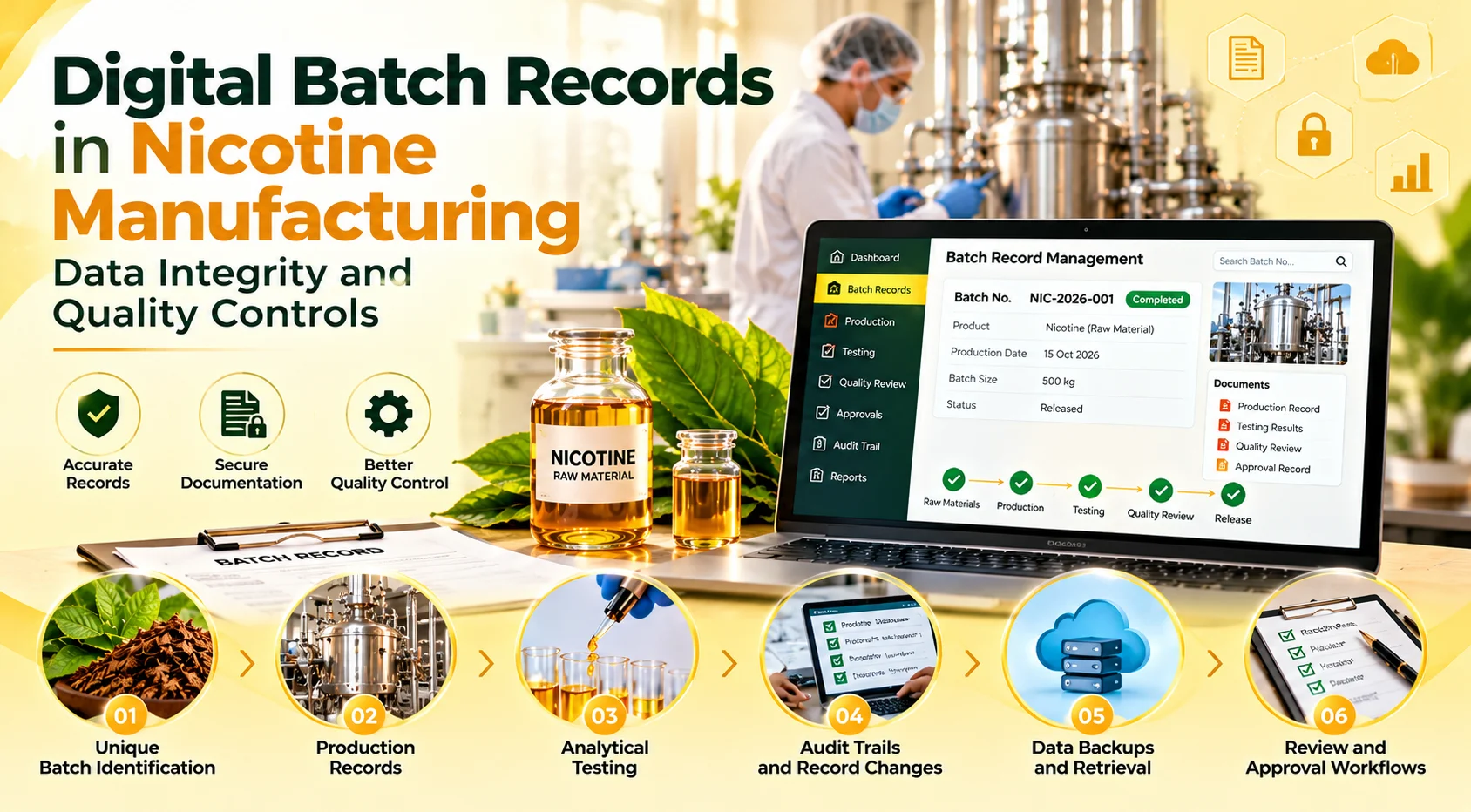
Digital Batch Records in Nicotine Manufacturing: Data Integrity and Quality Controls
Manufacturing records play an important role in documenting how a material is produced, tested, reviewed and released. As manufacturing operations adopt digital systems, electronic records can help teams organise production information and retrieve relevant documentation more efficiently.
For companies involved in nicotine raw-material manufacturing and supply, digital batch records in nicotine manufacturing offer a useful framework for discussing documentation accuracy, traceability, access controls and quality review.
The benefits depend on how the system is designed, operated and maintained. Moving records from paper to software does not, by itself, guarantee data accuracy or regulatory compliance.
What Are Digital Batch Records?
A digital batch record is an electronic record of relevant activities associated with the production of a particular batch.
Depending on the manufacturing process, it may contain material identifiers, production dates, equipment references, process observations, laboratory results, deviations and review approvals.
A well-controlled system helps authorised personnel connect these records to the correct batch and retrieve them when needed.
The specific content and retention requirements depend on the product, applicable regulations and the manufacturer’s quality system.
Why Data Integrity Matters in Manufacturing
Data integrity concerns the completeness, consistency and accuracy of information throughout its lifecycle.
In its guidance on data integrity and drug current good manufacturing practice, the U.S. Food and Drug Administration explains the importance of reliable and accurate records in regulated drug manufacturing.
For applicable pharmaceutical operations, records should be attributable to the person or system responsible, legible, recorded at the appropriate time, preserved as original data or an accurate copy, and accurate.
These principles help quality teams assess whether records provide a dependable account of manufacturing and testing activities.
The guidance relates to regulated drug manufacturing; companies handling other nicotine materials should determine which legal and quality requirements apply to their operations.
Five Controls for Reliable Digital Batch Records
1. Unique Batch Identification
Each batch should have an identifier that connects relevant production and quality records.
Consistent identification can help prevent confusion between different products, grades, production dates or supplier batches.
Manufacturers should define how identifiers are assigned, recorded, checked and linked to associated documents.
2. User Access and Accountability
Access controls help ensure that only authorised users can perform relevant actions within a system.
Depending on the system’s role, controls may include individual user accounts, permission levels, authentication and records identifying who entered or reviewed information.
Shared accounts can make it more difficult to establish accountability. Organisations should define suitable access policies and review them periodically.
3. Audit Trails and Record Changes
A controlled electronic system should preserve appropriate information about changes to important records.
Depending on the system and applicable requirements, this may include who made a change, when it occurred and what information was changed.
Corrections should follow approved procedures. Original information should remain available where required, rather than being silently overwritten.
The appropriate audit-trail functionality should be determined through system and quality-risk assessment.
4. Data Backups and Record Retrieval
Manufacturing records may be needed for investigations, customer enquiries, quality reviews or regulatory inspections.
Organisations should establish suitable backup, recovery, retention and retrieval arrangements based on the criticality of the records and applicable requirements.
A backup strategy should be tested periodically. Simply storing a copy of a file does not prove that the information can be restored accurately when required.
5. Review and Approval Workflows
Digital workflows can help identify records that require review before a batch-related decision is completed.
Depending on the operation, the review may include production entries, analytical results, deviations and relevant approvals.
The system should make outstanding actions visible and preserve appropriate evidence of completed reviews.
Automated status indicators should not replace the technical judgement or authorised decisions required by the applicable quality system.
How Digital Records Support Manufacturing Quality
Digital records can make it easier to locate information across production and quality functions.
For example, if an investigation identifies an unexpected result, authorised personnel may need to review the associated batch record, laboratory data, equipment information and any relevant deviations.
When these records are linked consistently, the investigation team can identify the relevant evidence more efficiently.
However, digitalisation cannot compensate for incomplete entries, poorly defined procedures or inadequate staff training. The quality of the underlying records and the controls surrounding them remain essential.
Regulatory Considerations for Electronic Manufacturing Records
Regulatory requirements differ according to product classification, intended use and jurisdiction.
FDA’s Q7 Good Manufacturing Practice Guidance for Active Pharmaceutical Ingredients discusses documentation systems, computerized systems, batch records, laboratory controls, data protection and record retention in the context of pharmaceutical active ingredients.
FDA also publishes guidance on data integrity and compliance with drug CGMP. These references can help organisations understand the expectations relevant to regulated pharmaceutical manufacturing.
Neither reference should be interpreted as establishing identical requirements for every nicotine raw material, industrial chemical or finished consumer product.
Before implementing an electronic record system, companies should assess applicable legislation, contractual obligations, validation expectations, electronic-signature requirements and record-retention rules.
Questions B2B Buyers Can Ask Manufacturers
When evaluating a supplier’s manufacturing documentation, buyers may ask:
- How are production batches uniquely identified?
- Which production and laboratory records are maintained?
- How are corrections and changes to records documented?
- How are records protected against unauthorised access or loss?
- Can relevant records be retrieved for an identified batch?
- Who reviews and approves the applicable documentation?
- Which quality and regulatory requirements apply to the supplied material?
These questions can help buyers understand the supplier’s documentation approach. They do not replace a formal supplier audit or any verification required by the buyer’s own quality system.
For related information, read Why Nicotine Batch Traceability Matters in Global Supply Chains.
Buyers can also review Nicotine Purity and Assay Results: A B2B Buyer’s Guide for background on analytical reporting.
Digital B2B Sourcing and Supplier Information
Digital platforms can help businesses discover potential suppliers, exchange enquiries and discuss preliminary product requirements. However, an online listing does not independently establish manufacturing quality, record integrity or regulatory compliance.
Businesses exploring industry-specific B2B sourcing can visit TradeNicotine.com to review the platform and its available supplier and buyer information.
Companies should independently verify counterparties, review relevant documentation and establish the requirements applicable to each transaction.
For company and product information, visit McCoy NIC International LLP.