Understanding Nicotine Purity, Assay Results and Analytical Reporting
Nicotine purity and assay results are important considerations for manufacturers, quality teams, and qualified B2B buyers evaluating nicotine raw materials. A reported purity value can help assess a material against an agreed specification, but interpreting that value correctly also requires understanding the analytical method, batch identification, test results, and supporting documentation.
In industrial procurement, analytical reporting provides a documented basis for reviewing product quality and determining whether a batch meets the applicable requirements. A clear report helps purchasing and quality teams work from the same specifications instead of relying on a product description or a headline purity figure alone.
What Is Nicotine Purity?
Nicotine purity describes the proportion of nicotine in a material as determined using a defined analytical approach. The reported value must be interpreted according to the test method, calculation basis, and specification applicable to that product.
A purity figure should not be treated as a complete description of quality. Other relevant parameters may include related compounds, water content, residual solvents, and additional tests required by the product specification or intended application.
For this reason, buyers should review the full specification and applicable analytical report rather than evaluating a material solely by its advertised purity.
What Are Nicotine Assay Results?
An assay is a test used to determine the amount or concentration of a specified substance in a sample. In a nicotine quality report, the assay result is compared with a defined acceptance limit or product specification.
For example, McCoy NIC lists a minimum 99.9% assay for its Pure Nicotine 99.9% grade. The applicable batch-specific Certificate of Analysis (CoA) is the appropriate document to review when assessing a particular consignment.
Buyers should distinguish between:
- Specification limit: The agreed requirement that a material must meet.
- Assay result: The reported analytical finding for the sample tested.
- Acceptance decision: The conclusion reached by comparing the result with the applicable criteria and quality procedures.
A result should not be described as compliant without considering the relevant limit, method, units, and any applicable reporting rules.
Purity Versus Assay: What Is the Difference?
The terms purity and assay are sometimes used together in commercial specifications, but their exact meaning depends on the material and the analytical method.
Purity is a broad description of the proportion of the desired substance relative to other components. Assay refers to a defined measurement used to quantify the substance under a particular method.
The two terms may be used closely in a product specification, but buyers should not assume that every purity claim is directly comparable across different methods or reporting bases.
When comparing two supplier reports, check whether both use compatible methods, units, calculation bases, and acceptance limits. If those details differ, ask the supplier or qualified laboratory to clarify the comparison before drawing a conclusion.
Which Analytical Methods May Be Used?
The appropriate analytical method depends on the material, the parameter being measured, the applicable specification, and the intended use of the result.
Examples of methods used for relevant nicotine quality parameters include:
- Gas chromatography (GC): May be used for nicotine assay or selected volatile components, depending on the validated method.
- High-performance liquid chromatography (HPLC): May be used for specified analytes where the method is suitable.
- Karl Fischer titration: Commonly used to determine water content.
- Infrared spectroscopy (IR): May be used for identity testing where appropriate.
- Gravimetric methods: ISO 13276:2020 describes a method for determining nicotine purity using tungstosilicic acid within its stated scope. <Cite refs={[“turn775044search0″,”turn775044search1”]}/>
These examples are not interchangeable methods for every test. A report should identify the method used for each relevant parameter, and the method should be appropriate for the material and purpose of the analysis.
Where a regulated application requires a particular standard or monograph, buyers should confirm the required edition, method, and acceptance criteria with their quality or regulatory team.
What Should a Nicotine Certificate of Analysis Include?
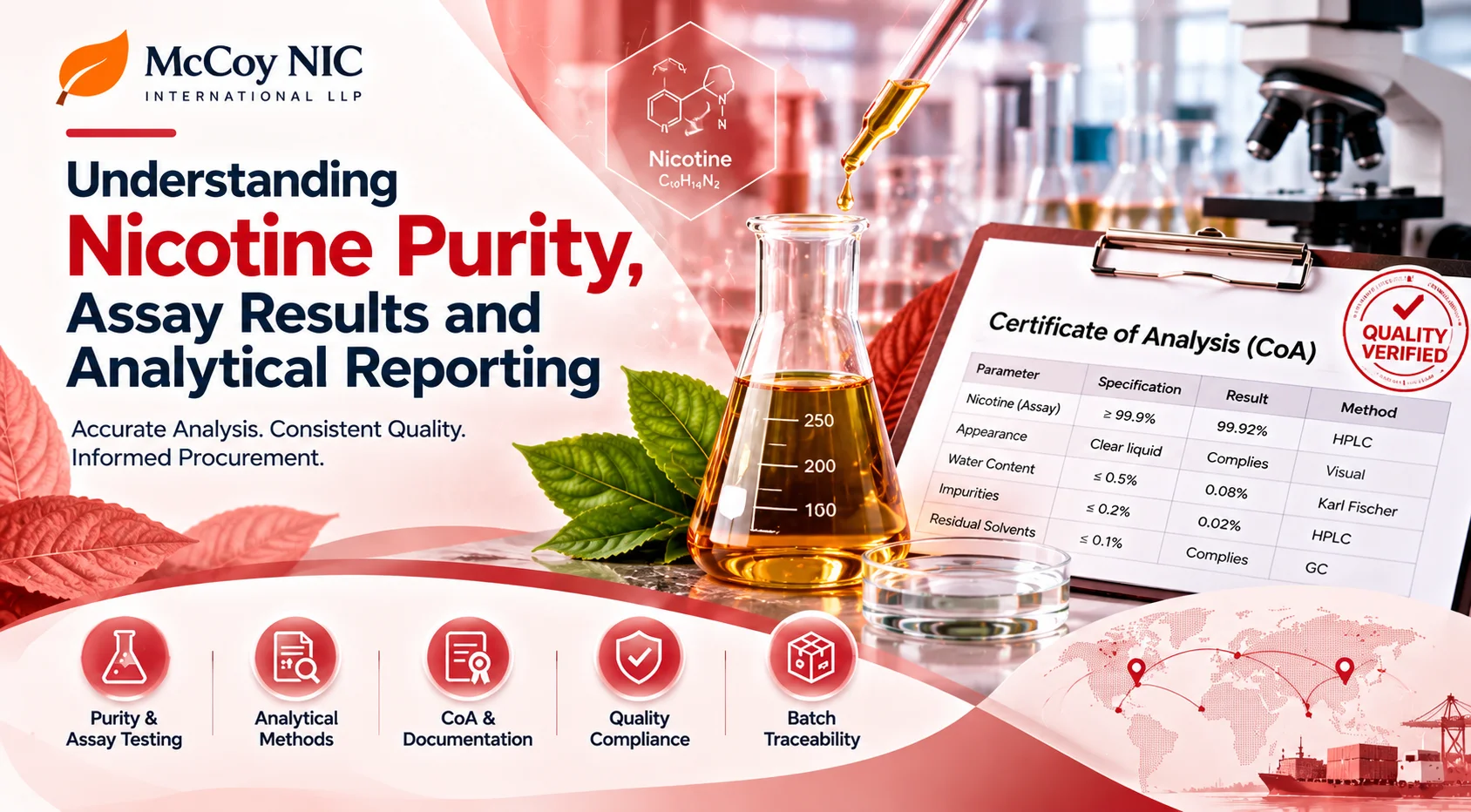
A Certificate of Analysis, or CoA, records the results and specifications associated with a particular batch or lot. It helps buyers verify that the documentation corresponds to the material being evaluated.
Depending on the product and applicable requirements, a CoA may include:
- Product name and grade
- Batch or lot number
- Specification reference
- Test parameters and acceptance limits
- Reported results and units
- Analytical methods or method references
- Relevant test dates
- Authorized review or release information
A buyer should check that the product identity and batch details match the supplied material. The reported results should also be reviewed against the specification that applies to that batch.
For more information, visit the McCoy NIC Certifications and Compliance Documents page. Buyers can also review the company’s nicotine procurement dossier for information about its stated documentation and specification approach.
How to Interpret an Assay Result Correctly
A reported result should always be read in context. A number without its units, method, sample identity, or acceptance limit may be insufficient for a reliable quality decision.
Procurement and quality teams should consider the following questions:
- Does the product name and grade match the purchase specification?
- Is the batch or lot number clearly identified?
- Is the reported result expressed on the expected basis?
- Is the method appropriate for the parameter being reported?
- Does the result meet the agreed acceptance limit?
- Are any required supporting tests or documents missing?
- Are there discrepancies that need clarification before acceptance?
If a result is close to an acceptance limit or appears inconsistent with previous records, the quality team should follow its established investigation and review procedures. Buyers should not change acceptance criteria informally to accommodate a result.
Why Batch Traceability Matters in Analytical Reporting
Analytical results are meaningful only when they can be linked to the correct sample and batch. Traceability helps establish which material was tested and which documentation relates to the delivered product.
For recurring procurement, batch identification can support comparisons across deliveries and help quality teams investigate unexpected results. It can also improve record retrieval during supplier reviews or internal audits.
Read our related article, Why Batch Traceability Is Becoming More Important in the Global Nicotine Supply Chain, for more on the role of batch-level records in B2B supply chains.
How to Compare Analytical Reports from Different Suppliers
Supplier reports should be compared only after confirming that the underlying requirements are sufficiently aligned. Differences in methods, test parameters, units, specification limits, or reporting conventions can make direct comparisons misleading.
A structured comparison may include:
- Product identity and grade
- Assay specification and reported result
- Analytical method and reference standard
- Related quality parameters
- Batch identification and document completeness
- Applicable quality or regulatory requirements
A higher headline assay value does not automatically establish that one material is more suitable for a particular application. The full specification, required quality attributes, and intended use must be considered together.
For supplier assessment, see How to Evaluate an Indian Nicotine Supplier.
Common Mistakes to Avoid
Several common mistakes can lead to incorrect interpretation of analytical reports:
- Comparing assay values without checking the analytical method.
- Treating purity as the only indicator of product quality.
- Ignoring the batch or lot number on a CoA.
- Assuming a supplier’s general specification replaces batch-specific results.
- Confusing a certificate or management-system credential with a batch test report.
- Assuming that a test result establishes compliance with every destination market’s requirements.
A consistent document-review process helps purchasing and quality teams identify gaps and request clarification before making a procurement or acceptance decision.
How McCoy NIC Supports Quality Documentation Review
McCoy NIC International LLP provides product information and documentation support for qualified B2B enquiries. Buyers can discuss the applicable grade, specification, and quality records required for their purchasing assessment.
For its listed pure nicotine grade, McCoy NIC describes batch-specific CoA documentation and relevant quality parameters on the Pure Nicotine 99.9% product page. The documentation applicable to an individual order should be confirmed directly with the company.
To discuss a product requirement or request relevant documentation, visit the Request COA and Price page.
Nicotine is acutely toxic in concentrated form. Procurement, sampling, storage, transport, and use must be handled by appropriately qualified personnel in accordance with the relevant safety documentation and applicable laws.
Frequently Asked Questions
What do nicotine assay results show?
Nicotine assay results report the measured amount or concentration of nicotine in a tested sample under a defined analytical method. The result should be compared with the applicable product specification.
Does 99.9% assay mean every impurity is absent?
No. A high assay result does not mean that every possible impurity is absent. Other relevant quality parameters may require separate tests and acceptance limits.
Why is the analytical method important?
The method defines how a parameter is measured. Method differences can affect comparability, so buyers should verify the method, reporting basis, and acceptance criteria before comparing results.
What is the role of a Certificate of Analysis?
A CoA records specified test results and related information for a particular batch or lot. It helps buyers assess the material against agreed requirements and maintain quality records.
Can two supplier assay results be compared directly?
Only when the product, reporting basis, methods, units, and applicable specifications are sufficiently comparable. Otherwise, clarification may be needed before drawing conclusions.