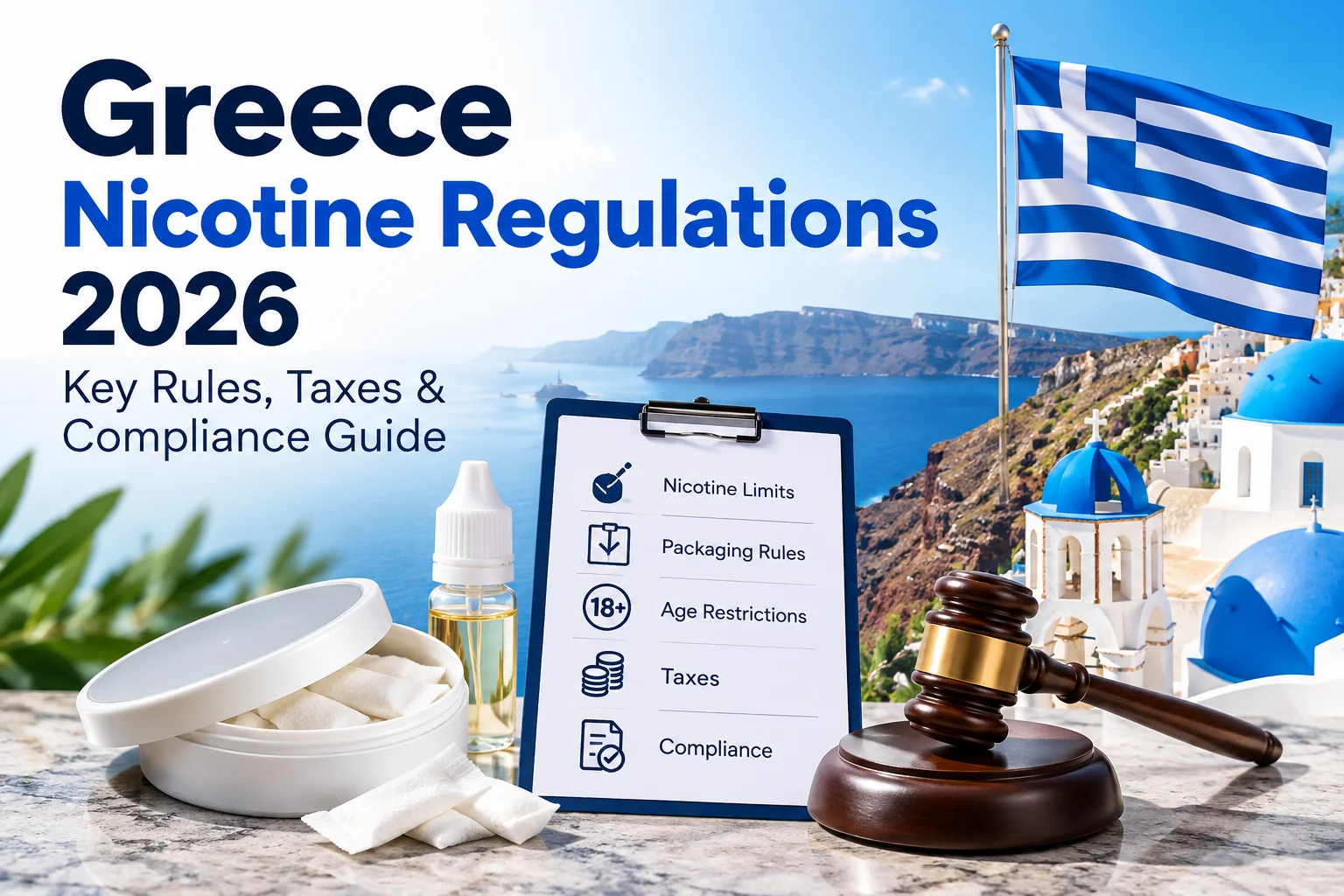
Greece nicotine regulations 2026 are important for manufacturers, importers, distributors and B2B buyers dealing with nicotine-containing products. Greece regulates tobacco and related products through national legislation alongside applicable European Union requirements.
In 2026, Greece introduced additional national requirements covering nicotine products and electrically heated tobacco-free products, including rules concerning sales channels, nicotine limits, packaging, labelling, age restrictions and enforcement.
For companies supplying nicotine raw materials or finished nicotine products to Greece, the first step is to identify the product category, intended use and applicable regulatory framework.
1. What Are the Main Nicotine Regulations in Greece?
Greece’s regulatory framework includes national legislation implementing and supplementing European tobacco-control requirements.
Important legislation includes:
- Law 4419/2016, which implements the EU Tobacco Products Directive framework.
- Law 5216/2025, which introduced additional provisions concerning nicotine products and new tobacco-related products.
- Law 5302/2026, which amended certain provisions concerning nicotine products, enforcement and penalties.
- Ministerial decisions issued in 2026 establishing specific requirements for nicotine products and electrically heated tobacco-free products.
The Greek Ministry of Health lists these laws and implementing decisions as part of the country’s current tobacco and related-product legislation.
For B2B manufacturers, compliance should therefore be assessed according to the exact product and its intended application rather than treating all nicotine products in the same way.
2. Nicotine Products and Market Access in Greece
The regulatory requirements can differ depending on whether the product is:
- A tobacco product
- An electronic cigarette
- A nicotine-containing refill liquid
- A nicotine pouch
- An electrically heated tobacco-free product
- A pharmaceutical or nicotine-replacement product
- Nicotine supplied as an industrial or manufacturing raw material
This distinction is particularly important for international B2B suppliers.
A manufacturer purchasing bulk nicotine as a raw material should not automatically assume that consumer-facing requirements apply in exactly the same way to the raw material. The final application, product classification and applicable legislation should be confirmed before commercial supply.
3. Nicotine Pouch Regulations in Greece
Nicotine pouches are an important area of the Greek regulatory framework in 2026.
Under the 2026 rules, nicotine pouches are subject to specific requirements concerning their nicotine content and packaging.
A key requirement is that each nicotine pouch may contain no more than 16 mg of nicotine. The rules also require unit packaging to be child-resistant in accordance with the relevant international standard.
Greek rules also establish requirements concerning the sale and distribution of nicotine products.
Because nicotine pouch legislation is developing across Europe, manufacturers should verify the current Greek requirements before placing a product on the market.
4. Maximum Nicotine Level for Nicotine Pouches
One of the important 2026 developments is the Greek maximum nicotine content for nicotine pouches.
Maximum nicotine per pouch: 16 mg
This requirement applies to nicotine pouches covered by the Greek regulatory framework.
For manufacturers, the specification should clearly identify:
- Nicotine content per pouch
- Product composition
- Batch specification
- Packaging configuration
- Child-resistant packaging
- Labelling requirements
- Product traceability
The Greek legislation amended in 2026 specifically provides for the 16 mg maximum per nicotine pouch.
5. Child-Resistant Packaging
Packaging is an important compliance consideration for nicotine products in Greece.
The 2026 provisions require nicotine-pouch packaging to meet child-resistant requirements based on ISO 8317.
For manufacturers and suppliers, packaging specifications should therefore be reviewed before commercial production.
A B2B quality file may include:
- Packaging specification
- Child-resistant packaging information
- Product specification
- Batch information
- Certificate of Analysis
- Safety Data Sheet
- Labelling information
- Traceability documentation
6. Age Restrictions for Nicotine Products
Greece has strict restrictions on the sale and distribution of tobacco and related products to minors.
The Ministry of Health states that the sale, offering or distribution of covered nicotine products to minors is prohibited. Sellers must verify that the purchaser is an adult using an accepted physical or digital identification method.
The 2026 framework also specifically prohibits the sale, offering or distribution of nicotine products to minors.
For businesses selling finished products in Greece, age verification should therefore form part of the compliance process.
7. Restrictions on Vending Machines
Greek rules also restrict the sale of nicotine products through vending machines.
The Ministry of Health states that the sale of nicotine products through vending machines is prohibited under the applicable provisions.
For manufacturers and distributors, this means that the intended retail channel should be reviewed before entering the Greek market.
8. Retail Display and Sales Conditions
The 2026 framework establishes specific conditions for the sale and display of nicotine products.
Nicotine products are generally required to be placed for sale in appropriate display arrangements within the retail premises, with access involving store personnel, subject to the exemptions provided by Greek law.
These requirements are particularly relevant to businesses selling finished nicotine products directly to consumers.
B2B raw-material suppliers should instead focus on the classification, documentation, import and intended-use requirements applicable to the raw material.
9. Product Labelling and Packaging
Labelling is another important consideration when supplying nicotine-containing products to Greece.
Depending on the product category, businesses may need to review:
- Product name
- Nicotine content
- Ingredients
- Safety information
- Required warnings
- Batch or lot identification
- Manufacturer/importer information
- Packaging specifications
- Child-safety requirements
- Applicable language requirements
The Greek Ministry of Health’s 2026 legislation specifically addresses labelling and packaging requirements for certain nicotine products.
10. Transition Period for 2026 Nicotine Products
The Greek March 2026 ministerial decision includes transitional provisions.
Certain electrically heated products and nicotine pouches already on the Greek market when the decision entered into force, or imported up to 31 December 2026, may continue to circulate until 31 March 2027 even if they do not yet meet certain specifications covered by the new rules.
From 1 January 2027, products newly imported into Greece must comply fully with the applicable provisions.
This transition period is particularly relevant for manufacturers and importers planning inventory and product launches.
11. EU Tobacco Product Rules and Greece
Greece’s national framework operates alongside applicable EU requirements.
The EU Tobacco Products Directive provides a common regulatory framework for tobacco products and certain related products across EU Member States.
However, EU-level rules do not mean that every nicotine product is regulated identically in every country.
Greece has introduced additional national provisions, so companies entering the Greek market should review both:
- Applicable EU requirements
- Current Greek national requirements
The European Commission also maintains information on national provisions notified by Member States under the Tobacco Products Directive.
12. Taxation of Nicotine Products in Greece
Tax treatment depends on the exact product category and its legal classification.
Nicotine pouches and other nicotine-containing products may be subject to specific Greek tax and excise provisions.
For example, current industry regulatory reporting identifies an excise tax of €50 per kg for nicotine pouches in Greece. Because tax rules can change and treatment depends on product classification, importers should verify the applicable rate and tax obligations before shipment.
For B2B procurement, the landed cost calculation should therefore consider:
- Product price
- Quantity
- Packaging
- Freight
- Customs
- Applicable excise
- VAT
- Import-related charges
13. Nicotine E-Liquids and Electronic Cigarettes
Electronic cigarettes and nicotine-containing refill products are regulated under Greece’s tobacco-related framework.
Manufacturers and importers should review requirements applicable to:
- Nicotine concentration
- Refill containers
- Product notification
- Packaging
- Labelling
- Health warnings
- Safety information
- Age restrictions
- Retail sales
The applicable requirements depend on the final product and its intended use.
Businesses should not assume that the requirements for nicotine pouches automatically apply to e-liquids or electronic cigarettes.
14. Nicotine Raw Material Requirements for B2B Buyers
Companies purchasing nicotine as a raw material for manufacturing should establish clear specifications before placing an order.
A technical procurement specification may include:
- Nicotine type
- Source
- Purity/assay
- Grade
- Intended application
- Certificate of Analysis (CoA)
- Safety Data Sheet (SDS)
- Manufacturing information
- Batch number
- Batch traceability
- Packaging requirements
- Storage requirements
- Transport requirements
- Import documentation
For international buyers, product classification and intended use should be confirmed before applying consumer-product regulations to a raw material.
For additional procurement guidance, see Factors That Affect Bulk Nicotine Procurement: A B2B Buyer’s Guide.
15. Why Batch Consistency Matters
Manufacturers using nicotine as a raw material need consistent specifications from batch to batch.
Quality teams may review:
- Assay
- Purity
- Appearance
- Analytical testing
- Batch number
- Manufacturing date
- Retest or expiry information where applicable
- CoA
- SDS
- Traceability records
Buyers can also compare supplier documentation against their own internal raw-material specifications.
For more information, see How Can Buyers Verify Batch-to-Batch Consistency in Nicotine?.
16. Building a Reliable Nicotine Supply Chain for Greece
International nicotine procurement involves more than selecting a supplier.
Manufacturers should consider:
- Product specifications
- Supplier qualification
- Quality documentation
- Batch consistency
- Packaging
- Lead time
- Shipping
- Import requirements
- Regulatory requirements
- Backup supply options
McCoy NIC’s guide on Building a Reliable Nicotine Raw Material Supply Chain provides additional information on supplier qualification and procurement planning.
17. What Should Greek B2B Buyers Check Before Purchasing Nicotine?
Before purchasing nicotine for manufacturing, buyers can review the following checklist:
Product
- Product category identified
- Intended use confirmed
- Nicotine type confirmed
- Required purity established
- Product specification approved
Quality
- Certificate of Analysis available
- Safety Data Sheet available
- Batch traceability available
- Testing requirements confirmed
- Packaging specification reviewed
Regulatory
- Greek product classification confirmed
- Applicable EU requirements reviewed
- Greek national requirements reviewed
- Labelling requirements checked
- Age restrictions reviewed where applicable
- Import requirements confirmed
Commercial
- Quantity confirmed
- MOQ confirmed
- Packaging agreed
- Lead time confirmed
- Shipping terms agreed
- Importer responsibilities established
18. Greece Nicotine Regulation Checklist for Manufacturers
| Area | What to Check |
|---|---|
| Product classification | Identify exact nicotine product category |
| Nicotine level | Confirm applicable product-specific limit |
| Nicotine pouches | Maximum 16 mg per pouch under 2026 rules |
| Packaging | Review child-resistant requirements |
| Labelling | Check applicable Greek/EU requirements |
| Age restrictions | No sale to minors |
| Vending | Review vending-machine restrictions |
| Tax | Confirm applicable excise/VAT treatment |
| Import | Review customs and import documentation |
| Quality | CoA, SDS and product specification |
| Traceability | Batch and supplier records |
| Transition rules | Check applicable 2026–2027 deadlines |
19. Greece vs Other European Nicotine Markets
Nicotine regulations differ between European countries.
For companies expanding across Europe, it is useful to compare Greece’s requirements with other national markets rather than assuming that one country’s rules apply throughout the EU.
McCoy NIC has also published regulatory guides covering other European markets, including:
- Nicotine Regulations in Portugal: Rules, Compliance & B2B Guide
- Nicotine Regulations in Ireland: Rules, Compliance & B2B Guide
- Nicotine Regulations in Poland: Rules, Compliance & B2B Guide
- Rules & Regulations of Nicotine in Estonia
These country-specific guides can help manufacturers compare market-entry considerations across Europe.
20. McCoy NIC and International B2B Nicotine Supply
For qualified B2B buyers, McCoy NIC International LLP provides nicotine raw materials and nicotine salts for manufacturing applications.
International buyers may require:
- Product specifications
- Purity information
- Certificate of Analysis
- Safety Data Sheet
- Batch information
- Packaging details
- Supply coordination
- Export documentation
Supplier qualification should be based on the buyer’s technical, quality and regulatory requirements.
For additional information about international B2B sourcing, see McCoy NIC Expands Support for International Nicotine Buyers.
Conclusion
Greece nicotine regulations 2026 include important requirements for tobacco products, electronic cigarettes, nicotine pouches and other nicotine products.
The 2026 Greek framework introduces specific requirements for nicotine pouches, including a maximum of 16 mg nicotine per pouch, child-resistant packaging provisions and restrictions concerning sales to minors and vending machines.
The Greek regulatory framework also includes transitional provisions extending certain compliance deadlines into 2027 for products covered by the March 2026 decision.
For B2B manufacturers and raw-material buyers, the most important starting points are product classification, intended use, technical specifications, quality documentation, packaging, import requirements and supplier qualification.
Businesses planning to manufacture, import or sell nicotine-containing products in Greece should verify the current requirements with the relevant Greek authorities and obtain product-specific regulatory advice before commercialisation.
Frequently Asked Questions
What is the maximum nicotine content in a nicotine pouch in Greece?
Under the 2026 Greek provisions, each nicotine pouch cannot contain more than 16 mg of nicotine.
Can nicotine products be sold to minors in Greece?
No. Greek law prohibits the sale, offer or distribution of covered nicotine products to minors. Age verification requirements apply to sellers.
Are nicotine pouches regulated in Greece?
Yes. Greece introduced specific national requirements for nicotine pouches in 2026, including nicotine-content and packaging provisions.
Does Greece regulate nicotine packaging?
Yes. The 2026 framework includes packaging and labelling requirements for covered nicotine products, including child-resistant packaging provisions for nicotine pouches.
Are vending-machine sales of nicotine products allowed in Greece?
Greek rules prohibit the sale of covered nicotine products through vending machines.
Do EU nicotine rules automatically apply identically in Greece?
No. Greece applies relevant EU requirements together with its own national legislation and implementing measures. Businesses should check the Greek requirements applicable to the specific product.
What documents should B2B buyers request from a nicotine supplier?
Depending on the application, buyers may request a Certificate of Analysis, Safety Data Sheet, product specification, batch information, traceability information, packaging details and relevant regulatory/import documentation.