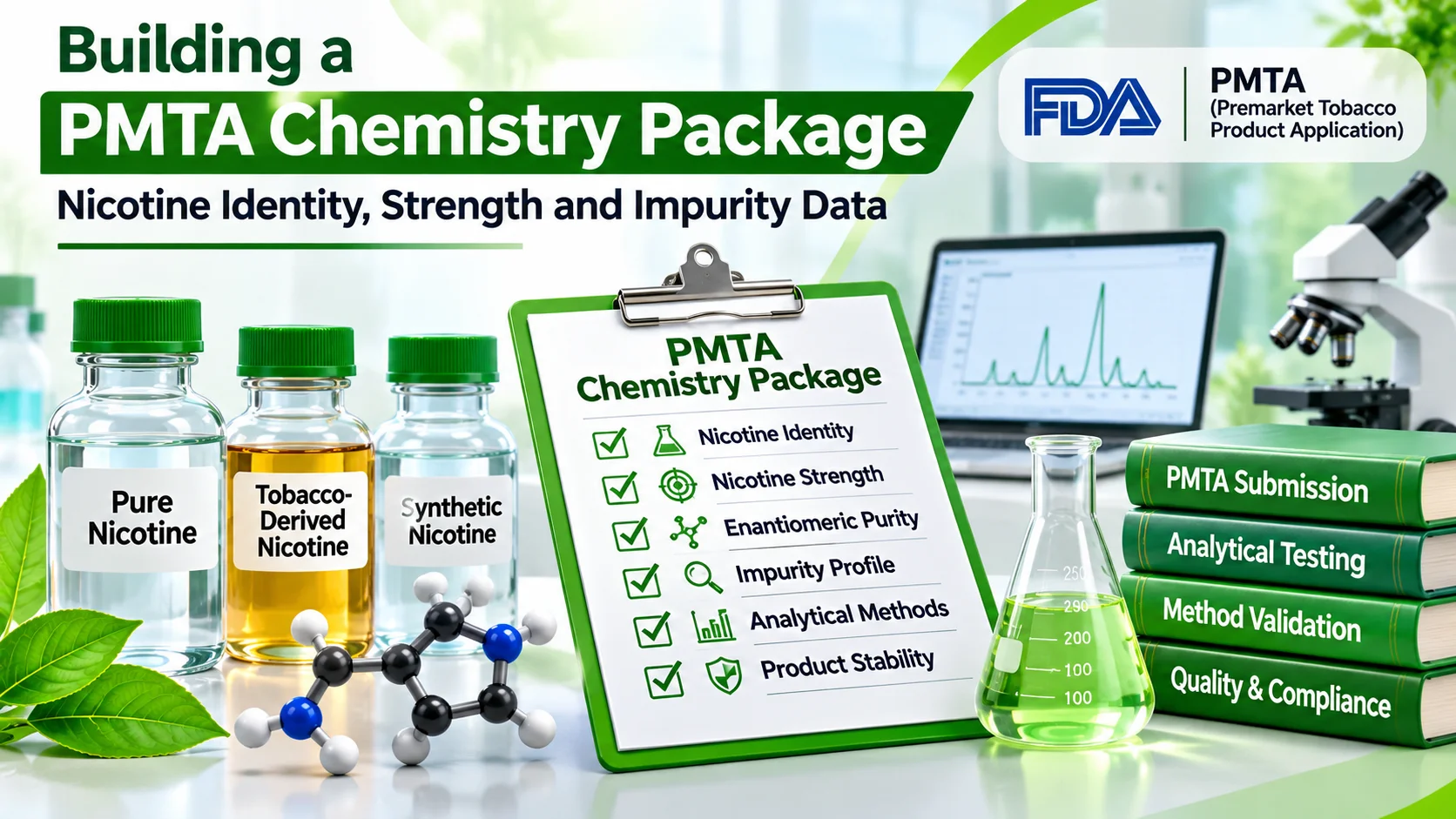
Building a PMTA Chemistry Package: Nicotine Identity, Strength and Impurity Data
Preparing a Premarket Tobacco Product Application (PMTA) requires more than submitting a product specification or a Certificate of Analysis (COA). Manufacturers must provide scientifically supported information that allows the US Food and Drug Administration (FDA) to understand the product’s composition, nicotine characteristics, manufacturing controls and potential health risks.
For nicotine-containing products, the chemistry package is particularly important. Nicotine identity, source, chemical form, strength, purity, impurity profile and analytical testing methods all contribute to product characterisation.
In February 2026, FDA representatives discussed these technical expectations during a roundtable on PMTA submissions for electronic nicotine delivery system products. The discussion highlighted the importance of detailed nicotine-source information, acceptable quantity ranges, enantiomeric purity for non-tobacco nicotine and validated analytical methods.
This makes a well-documented chemistry package an important part of preparing a scientifically complete PMTA submission.
1. What Is a PMTA Chemistry Package?
A PMTA chemistry package is the technical information used to describe and characterise a proposed new tobacco product. It supports the FDA’s assessment of product composition, physical properties, manufacturing and potential exposure to harmful or potentially harmful constituents.
Under the PMTA requirements in 21 CFR Part 1114, an application must include information about product formulation, manufacturing, product characteristics and other relevant scientific information.
The FDA’s PMTA preparation and submission guidance explains the application sections and information manufacturers should provide.
A chemistry package may include:
- Complete ingredient identification and formulation information.
- Nicotine source, chemical form and concentration.
- Ingredient purity and quality specifications.
- Analytical methods and supporting validation information.
- Relevant impurity and harmful constituent data.
- Product stability information.
- Manufacturing and quality-control procedures.
- Supporting batch records and laboratory reports.
The information should be product-specific, traceable and presented in a well-organised format.
2. Nicotine Identity: Establishing Exactly What Is in the Product
Nicotine identity is one of the first areas that manufacturers should address in their chemistry documentation.
A submission should clearly identify the nicotine used in the formulation and provide relevant chemical information. Describing an ingredient simply as “nicotine” may not provide sufficient technical detail for a meaningful product assessment.
The FDA’s February 10, 2026 PMTA chemistry roundtable specifically highlighted the importance of identifying:
- Nicotine source: tobacco-derived or non-tobacco nicotine.
- Nicotine form: salt or unprotonated nicotine.
- Specific chemical form or name.
- Target nicotine quantities and acceptable ranges.
- Enantiomeric purity information for non-tobacco nicotine.
This distinction matters because tobacco-derived and synthetic nicotine may require different supporting characterisation information.
For example, manufacturers using synthetic nicotine should not assume that a general purity result alone provides all the information needed to describe the material. The source, chemical identity and relevant stereochemical characteristics should also be addressed.
The FDA’s February 2026 PMTA roundtable transcript provides further details about the agency’s discussion of nicotine characterisation.
Businesses sourcing different nicotine materials can also review McCoy NIC’s information on Pure Nicotine, Tobacco-Derived Nicotine and Synthetic Nicotine.
3. Nicotine Strength: Why Target Concentration and Measured Results Matter
Nicotine strength is a central part of product formulation and exposure assessment.
Manufacturers should document the target nicotine concentration, the relevant units of measurement, acceptable formulation ranges and actual analytical results.
A useful nicotine strength dataset should identify:
- Target nicotine concentration.
- Acceptable upper and lower limits.
- Measured concentration in the tested product.
- Analytical method used for measurement.
- Sample identification and batch reference.
- Number of replicates, where applicable.
- Mean result and relevant variability information.
The units should be appropriate for the product and clearly defined. For example, a liquid formulation may use mg/mL or percentage by weight, while other product matrices may require different units.
Manufacturers should also ensure that the formulation target, manufacturing records, product specifications and laboratory results are consistent.
In its February 2026 roundtable, FDA discussed the need for target nicotine quantities and acceptable ranges as part of product characterisation. The agency also highlighted the importance of comprehensive nicotine-content methods to support the evaluation of product exposure and abuse liability.
4. Nicotine Enantiomeric Purity: An Important Consideration for Synthetic Nicotine
Nicotine has two enantiomeric forms, commonly identified as R-nicotine and S-nicotine. These forms have the same molecular formula but differ in their three-dimensional arrangement.
For non-tobacco nicotine, enantiomeric composition is an important part of chemical characterisation.
During its February 2026 PMTA roundtable, FDA specifically stated that information about enantiomeric purity is needed for non-tobacco nicotine scientific review.
This means manufacturers using synthetic nicotine should consider whether their analytical programme can distinguish and quantify the relevant enantiomeric forms.
Supporting documentation may include:
- The analytical method used to assess enantiomeric composition.
- Identification of the relevant enantiomers.
- Measured results and units.
- Reference standards used.
- Method performance and validation information.
- Batch-specific results, where applicable.
A conventional assay measuring total nicotine concentration should not automatically be treated as an enantiomeric purity assessment. These are different analytical questions and may require different methods.
For further technical context, manufacturers can consult the FDA February 2026 PMTA roundtable transcript.
5. Impurity Profile: Identifying and Evaluating Relevant Chemical Components
An impurity profile helps manufacturers understand the quality and chemical composition of nicotine raw materials and finished products.
Impurities may originate from raw materials, manufacturing processes, storage conditions, degradation or interactions between formulation ingredients.
For PMTA chemistry documentation, businesses should establish an appropriate testing programme based on the material, product matrix, manufacturing process and relevant analytical risk assessment.
Areas that may require consideration include:
- Process-related impurities.
- Residual solvents, where relevant to the manufacturing process.
- Related substances and nicotine degradants.
- Relevant contaminants from raw materials.
- Product-specific harmful or potentially harmful constituents (HPHCs).
- Chemical changes during storage and product use, where applicable.
The specific testing programme should be scientifically justified. A generic impurity list should not be assumed to apply identically to every nicotine source or finished product.
FDA’s February 2026 roundtable discussed the need for complete product characterisation and measured HPHC information, including constituent names, means, standard deviations and replicate numbers. The discussion also highlighted the importance of product stability and monitoring relevant chemical changes over the proposed shelf life.
For additional background on the chemistry responsibilities involved in e-liquid manufacturing reviews, manufacturers can consult the FDA’s Memorandum on E-liquid Manufacturing Evaluation Responsibilities.
6. Analytical Testing Methods: Supporting Reliable Chemistry Data
A laboratory result is only as useful as the analytical method supporting it.
Manufacturers should describe the analytical procedures used to identify and measure nicotine, relevant impurities and other product constituents. The method should be appropriate for the product matrix and the intended analyte.
FDA’s January 2025 final guidance, Validation and Verification of Analytical Testing Methods Used for Tobacco Products, provides recommendations for presenting scientifically supported analytical testing information in tobacco product applications.
The guidance discusses important method-performance characteristics, including:
- Accuracy: How closely the measured result represents the true or accepted reference value.
- Precision: The consistency of results obtained through repeated measurements.
- Selectivity: The ability of the method to measure the intended analyte in the presence of other components.
- Sensitivity: The ability of the method to measure the analyte at relevant levels.
Manufacturers should retain supporting method documentation, reference standards, validation or verification reports, calculations and relevant laboratory records.
FDA explains these recommendations in its January 2025 analytical testing guidance.
The agency has also clarified that the guidance recommendations are non-binding. Alternative scientifically appropriate approaches may be considered, provided the method is adequately supported.
7. Certificate of Analysis: Connecting Raw Material Quality With PMTA Documentation
A Certificate of Analysis is an important document for incoming nicotine material and supplier qualification.
However, a COA should not be treated as a complete PMTA chemistry package. It normally reports selected test results for a particular material or batch, whereas a PMTA requires broader product-specific information.
A useful nicotine raw material COA may contain:
- Product and material identification.
- Batch or lot number.
- Test parameters.
- Specification limits.
- Actual analytical results.
- Units of measurement.
- Testing method or reference standard.
- Date of analysis and relevant approval details.
For nicotine materials, the manufacturer should determine whether additional supporting information is needed for source identification, chemical form, enantiomeric purity, impurity characterisation and method validation.
Supplier qualification records should also document the criteria used to approve raw materials and the procedures for incoming inspection and acceptance.
FDA’s e-liquid manufacturing evaluation memorandum discusses supplier selection, incoming shipment inspection, COAs, purity, quality control, acceptance criteria and testing methods for purchased ingredients.
8. Product Stability: Monitoring Nicotine and Related Chemical Changes
A chemistry package should also address whether the product maintains its intended characteristics throughout its proposed shelf life.
Stability studies help manufacturers understand how storage conditions and time may affect product composition and quality.
Depending on the product and its formulation, relevant assessments may include:
- Nicotine concentration over time.
- Relevant nicotine degradants.
- Changes in other selected chemical constituents.
- Physical appearance and formulation characteristics.
- Microbial quality, where applicable.
- Storage conditions and packaging suitability.
Testing should be designed around the product’s characteristics and the risks being evaluated. A suitable study plan should define the testing intervals, storage conditions, acceptance criteria and analytical procedures.
FDA’s February 2026 PMTA roundtable discussed chemical and microbial stability assessment, including measurements at the beginning, middle and end of the proposed shelf life. The discussion also highlighted monitoring nicotine and relevant chemical changes during storage.
9. Organising a PMTA Chemistry Documentation Package
A well-organised package makes it easier to trace information from the raw material through manufacturing and finished-product testing.
A practical documentation structure may include:
| Section | Supporting information |
|---|---|
| Nicotine identity | Chemical name, source and form |
| Nicotine strength | Target concentration, limits and measured results |
| Enantiomeric purity | Relevant analytical results for non-tobacco nicotine |
| Impurity profile | Relevant impurity and related-substance data |
| Analytical methods | Method descriptions and validation reports |
| Raw material quality | COAs, specifications and supplier records |
| Manufacturing controls | Process steps, controls and batch records |
| Product stability | Stability protocol and test results |
| HPHC assessment | Relevant measured constituent data |
The information should be consistent across specifications, laboratory reports, manufacturing records and the application itself.
FDA’s PMTA application requirements also explain the importance of a comprehensive index, table of contents, clear organisation and electronic submission format.
10. Conclusion: Strong Chemistry Data Supports a More Complete PMTA
Building a PMTA chemistry package requires a structured approach to nicotine identity, strength, impurity characterisation and analytical testing.
The FDA’s February 2026 roundtable reinforces the importance of detailed nicotine-source information, chemical form, target quantities, enantiomeric purity for non-tobacco nicotine and reliable analytical methods. Its January 2025 guidance also provides recommendations for validating and verifying analytical procedures used in tobacco product applications.
For manufacturers and suppliers, the priority should be to maintain traceable raw material documentation, scientifically supported laboratory results, appropriate impurity assessments and product-specific stability data.
A complete and clearly organised chemistry package can help support the scientific review of a PMTA. However, submitting chemistry documentation alone does not guarantee FDA marketing authorisation. The application must satisfy all applicable statutory and regulatory requirements.
Regulatory note: FDA announced on September 28, 2026, that it intends to evaluate changes to the PMTA regulatory framework. Applicants should therefore check the latest FDA requirements and submission instructions before filing.