Nicotine Regulations in Russia 2026: Import Rules, Licensing and Compliance
Nicotine regulations in Russia are an important consideration for international manufacturers, exporters, and B2B buyers involved in nicotine ingredients and nicotine-containing products. In 2026, businesses must pay close attention to product classification, licensing, customs requirements, technical documentation, and applicable Russian legislation.
Russia has a specific regulatory framework for tobacco products, nicotine-containing products, and nicotine raw materials. However, the requirements applicable to an industrial nicotine ingredient may differ from those governing a finished consumer product.
Understanding these distinctions can help importers prepare documentation and assess applicable regulatory obligations before arranging a shipment. Businesses should verify current requirements with the relevant Russian authorities and qualified customs specialists, as obligations may vary according to product classification, intended use and applicable legislation.
Sanctions, Banking and Shipping Restrictions Affecting Russia
Exports to Russia may be affected by sanctions, export controls, financial restrictions, and the policies of banks, insurers, courier companies, and freight carriers. The applicable restrictions depend on the parties involved, the product, its origin, the transaction, and the transport route.
Before accepting an order, exporters and importers should screen the relevant companies and individuals, confirm whether the product and transaction are permitted, and obtain confirmation from their bank and logistics provider. They should also check applicable export-control and sanctions requirements in the exporting country and any relevant transit jurisdiction.
If a transaction is prohibited or a service provider cannot lawfully support it, the parties should not proceed with that transaction. They should not misdescribe goods, conceal parties, or route payments or shipments to evade restrictions. Seek advice from qualified sanctions and trade-compliance professionals before committing to a shipment.
reduce avoidable shipment delays.
1. Overview of Nicotine Regulations in Russia
The Russian regulatory framework includes Federal Law No. 203-FZ of June 13, 2023, which governs aspects of the production and circulation of tobacco products, nicotine-containing products, and raw materials used in their manufacture.
Another important law is Federal Law No. 15-FZ, which addresses public health protections relating to tobacco and nicotine-containing products.
Businesses should determine which legal provisions apply to their particular product before importing, manufacturing, distributing, or selling it.
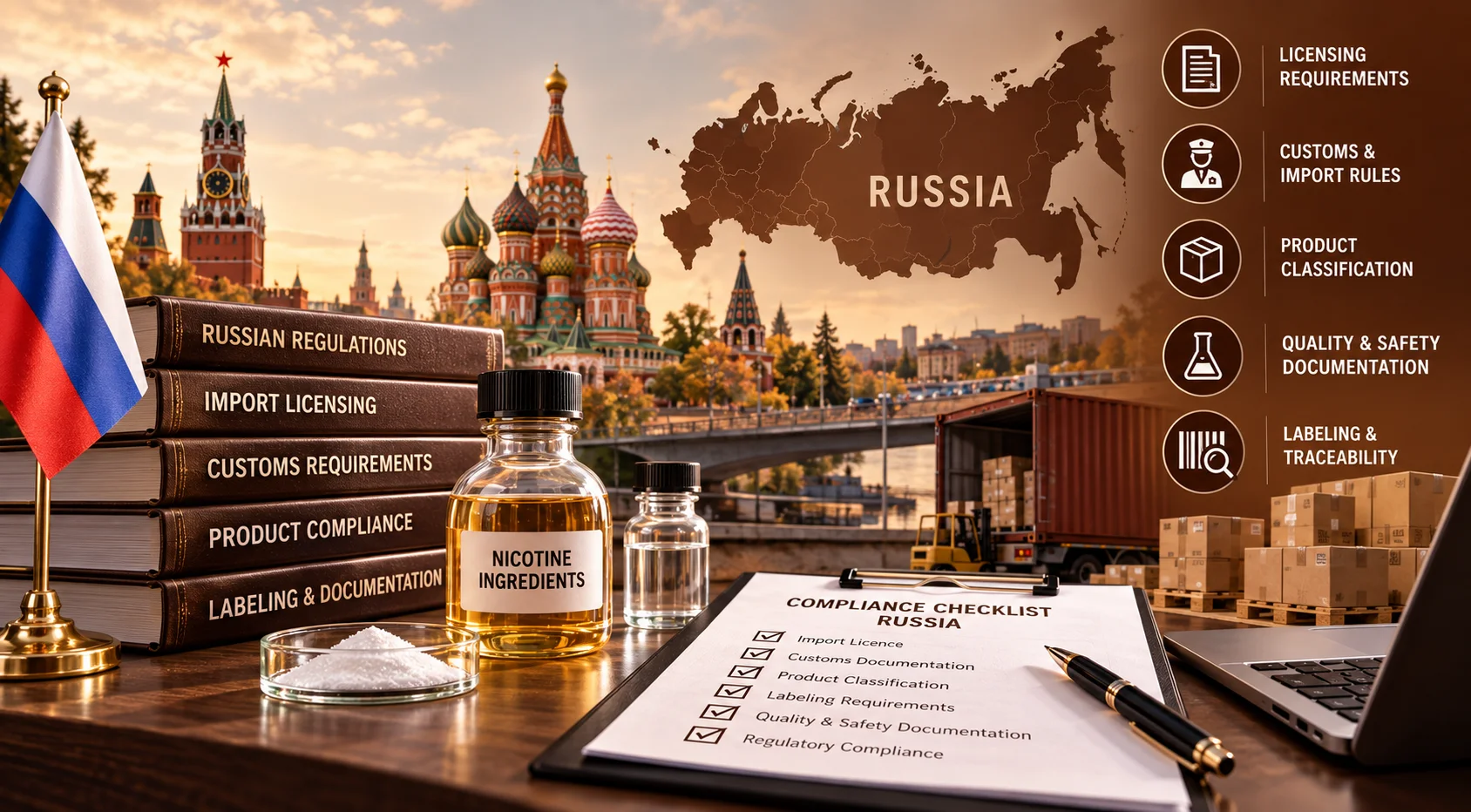
Key compliance considerations include:
- Classification of the nicotine ingredient or finished product
- Applicable business licensing requirements
- Customs declarations and import documentation
- Product quality and safety information
- Packaging, labeling, and traceability obligations
- Restrictions affecting particular consumer product categories
These requirements should be reviewed with a qualified Russian regulatory specialist before commercial shipment.
Federal Law 15-FZ and Chestny ZNAK Product Marking
Federal Law No. 15-FZ establishes public-health protections relating to tobacco and nicotine-containing products in Russia. Product classification, packaging, and marking requirements must be checked against the applicable Russian legislation and implementing rules.
Russia also operates a mandatory identification-marking and traceability framework known as Chestny ZNAK for specified tobacco and nicotine-containing product categories. Government rules set out requirements for marking covered products and reporting relevant product movements through the monitoring system. Importers should confirm whether their exact product category is covered and verify the applicable marking and conformity-document requirements before shipment.
These consumer-product marking rules should not automatically be assumed to apply identically to every bulk industrial nicotine ingredient.
Official references: Federal Law No. 15-FZ and Russian Government marking rules.
2. Nicotine Raw Materials vs. Finished Nicotine Products
One of the most important aspects of nicotine regulations in Russia is distinguishing between nicotine raw materials and finished nicotine-containing products.
Under Federal Law No. 203-FZ, the term nicotine raw material includes nicotine liquids and salts with a nicotine content exceeding 20 mg/mL.
This legal definition is particularly relevant for businesses handling concentrated nicotine ingredients.
Finished nicotine-containing products intended for consumer use may be subject to additional requirements relating to distribution, retail sales, product identification, and public health protections.
Consequently, importers should not assume that the rules governing a consumer vaping product automatically apply in the same way to bulk nicotine ingredients.
For technical information about industrial nicotine ingredients, buyers can review the McCoy NIC pure nicotine product page.
3. Licensing Requirements for Nicotine Businesses in Russia
Licensing is an important part of Russia’s nicotine regulatory framework.
Federal Law No. 203-FZ establishes licensing requirements for specified activities involving nicotine-containing products and nicotine raw materials.
Depending on the activity, licensing provisions may apply to manufacturing, associated storage and supply operations, or the introduction of certain regulated products into circulation through importation.
Importers should verify:
- Whether the intended activity requires a Russian licence.
- Whether the Russian importer or manufacturer holds the appropriate authorisation.
- Whether the product falls within the relevant statutory category.
- Whether additional registration or operational requirements apply.
A supplier’s commercial quotation or technical specification does not replace a legally required authorisation.
4. Russia Nicotine Import Regulations and Customs Documentation
Importing nicotine ingredients into Russia requires careful customs planning.
The documentation needed for a shipment depends on the product’s customs classification, composition, intended use, country of origin, and applicable import controls.
Importers should normally prepare or review the following documents as part of their shipment planning:
- Commercial invoice
- Packing list
- Sales contract or purchase agreement
- Product technical specification
- Certificate of Analysis (COA)
- Safety Data Sheet (SDS)
- Transport and shipping documents
- Country-of-origin documentation, where applicable
- Applicable licences, declarations, or conformity documents
Not every document is necessarily mandatory for every shipment. Russian customs brokers and regulatory advisers should confirm the exact requirements for the product.
The importer should also establish the correct Eurasian Economic Union customs tariff classification before calculating duties or arranging clearance.
EAEU Customs and Import Compliance
Russia is part of the Eurasian Economic Union (EAEU), so importers must assess the applicable EAEU customs framework alongside Russian national requirements. Before shipping nicotine-related goods, the importer should confirm the correct EAEU tariff classification, customs procedure, country-of-origin documentation, and any applicable conformity assessment or permit requirements. Requirements depend on the product category and intended use; a Certificate of Analysis or Safety Data Sheet alone does not establish customs eligibility or regulatory approval.
Importers should confirm the requirements with a qualified Russian customs broker and consult the official Eurasian Economic Commission website.
5. Product Quality and Safety Documentation
Documentation plays a significant role in international nicotine procurement.
A Certificate of Analysis can provide batch-specific technical information, while a Safety Data Sheet supports hazard communication, handling, storage, and transport planning.
For nicotine raw materials, buyers may also request information relating to:
- Nicotine concentration and purity
- Batch identification
- Relevant impurities and test methods
- Storage conditions
- Packaging specifications
- Shelf life or retest information, where supported
- Intended industrial application
These documents help buyers evaluate material specifications. They do not, by themselves, establish that a product is authorised for import or sale in Russia.
Buyers seeking supplier documentation can visit McCoy NIC’s certification and documentation page.
6. Labeling, Traceability and Product Monitoring
Russia has mandatory identification-marking and monitoring requirements for specified tobacco and nicotine-containing product categories.
For covered finished products, businesses may need to comply with product marking, reporting, and monitoring-system obligations.
Regulatory changes affecting the acceptance and verification of conformity documentation for certain imported marked products also took effect during 2026.
Importantly, businesses should verify whether their specific goods are included in these schemes rather than assuming that every bulk nicotine ingredient requires the same consumer-product identification marking.
Packaging and transport labeling should also be assessed separately according to the product’s hazard classification and applicable transport requirements.
7. What Changed in Russia’s Nicotine Rules in 2026?
Russia’s regulatory framework for nicotine-related products may change over time. Businesses should review the latest applicable legislation and official government guidance before importing or distributing these products.
Regulatory requirements may depend on the product classification, intended use, nicotine concentration and the relevant legal provisions. Importers should verify the current status and applicability of Federal Law No. 186-FZ and Federal Law No. 203-FZ through official Russian legal sources before relying on specific amendments or effective dates.
Any nicotine concentration threshold, including a reference to 20 mg/mL, should be confirmed against the applicable legislation for the specific product category. Buyers should not assume that one threshold applies to every nicotine ingredient or finished product.
Businesses should also distinguish between requirements governing raw nicotine ingredients and those applicable to finished consumer products, including vaping products. Licensing, retail restrictions and regional measures may have different scopes and implementation dates.
Before arranging a shipment, importers should confirm the applicable requirements with the relevant authorities or qualified customs specialists. This helps reduce the risk of relying on outdated or incorrectly interpreted regulatory information.
8. Shipping and Handling Nicotine Ingredients to Russia
Concentrated nicotine materials require appropriate safety and logistics planning.
Before arranging a shipment, exporters and Russian importers should confirm:
- The correct transport classification
- Packaging compatibility and integrity
- Required hazard labels and shipping declarations
- Carrier acceptance of the material
- Storage and temperature requirements, where relevant
- Transit-country restrictions
- Customs and import permissions
International shipments may also be affected by sanctions, export controls, financial restrictions, and carrier policies.
These matters require separate transaction-specific screening. Regulatory permission to import a product does not automatically mean that every exporter, buyer, bank, route, or payment method is permitted.
9. Compliance Checklist for Russian Nicotine Buyers
Before confirming an international nicotine procurement order, Russian buyers should consider the following questions:
Product classification: Is the material nicotine raw material, a finished nicotine-containing product, or another regulated category?
Importer authorisation: Does the importing business have all required licences and registrations?
Technical documentation: Are the COA, SDS, and specifications available and suitable for the transaction?
Customs requirements: Has the correct tariff classification been confirmed?
Marking and conformity: Are identification marking or conformity documents required for this specific product?
Logistics: Can the material be transported legally and safely using the selected route?
Trade restrictions: Have relevant sanctions, export controls, and payment restrictions been reviewed?
Completing these checks before shipment can support more efficient procurement planning.
10. Why Regulatory Awareness Matters for B2B Nicotine Procurement
International buyers need reliable technical information and a clear understanding of their regulatory responsibilities.
Regulatory awareness helps procurement teams communicate accurate product requirements, evaluate documentation, coordinate with customs specialists, and plan shipments more effectively.
For suppliers, providing clear technical specifications and consistent batch documentation can support professional communication with buyers.
McCoy NIC provides information about nicotine ingredients for business-to-business enquiries. Buyers remain responsible for confirming the laws and approvals applicable to their own markets and intended applications.
Learn more through the McCoy NIC website.