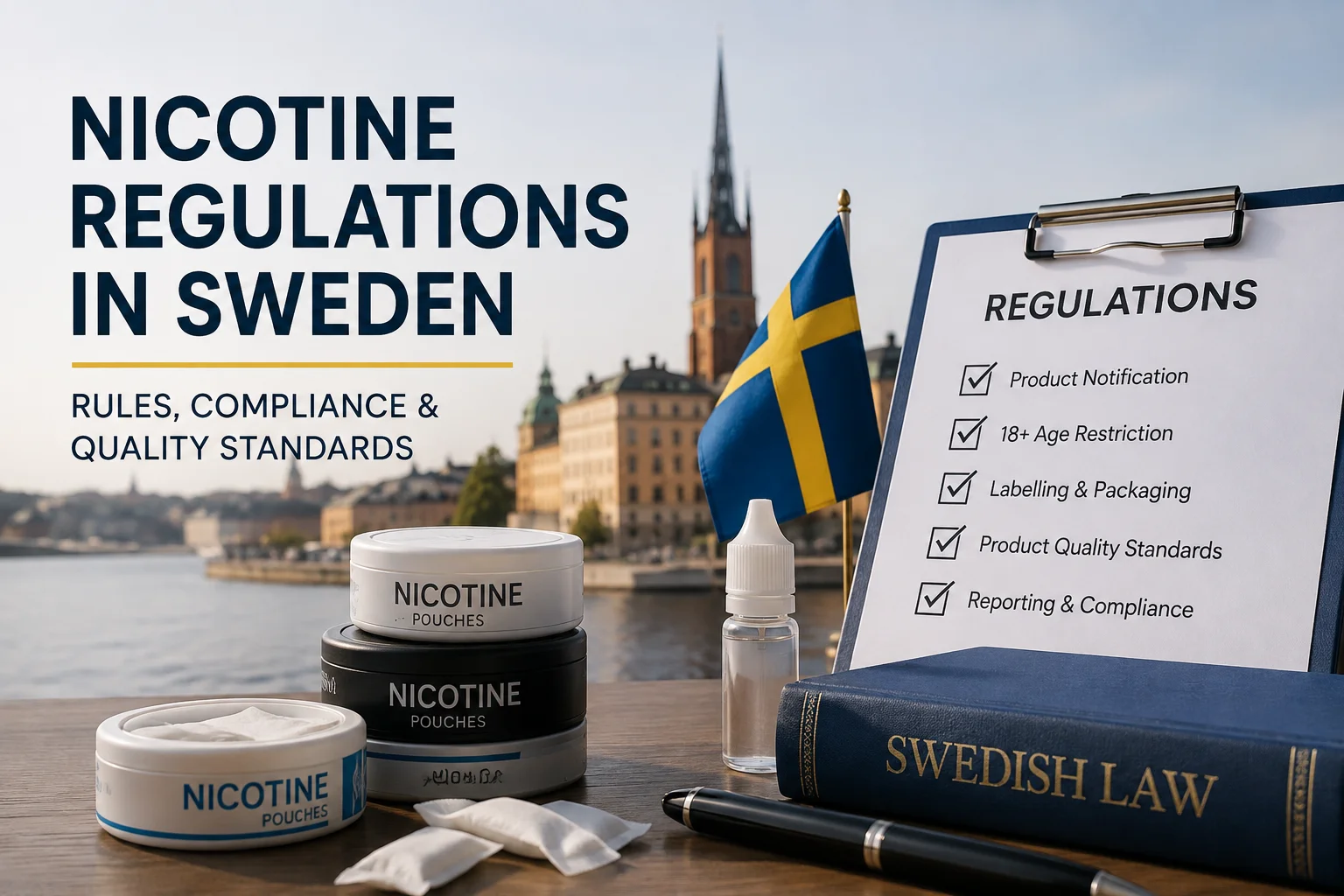
Rules & Regulations of Nicotine in Sweden: A Guide for Manufacturers and Buyers
Nicotine regulations in Sweden cover a range of requirements for tobacco-free nicotine products, including product notification, labelling, sales, product quality and market supervision.
Sweden has established a specific regulatory framework for tobacco-free nicotine products, covering product requirements, notification, labelling, sales and market supervision. For manufacturers, importers, distributors and buyers supplying nicotine products to the Swedish market, understanding these requirements is important for regulatory compliance.
Sweden’s Regulatory Framework for Nicotine Products
Tobacco-free nicotine products in Sweden are regulated under the Act (2022:1257) on Tobacco-Free Nicotine Products. The legislation covers areas including product notification, product requirements, sales and marketing. The Public Health Agency of Sweden is responsible for important aspects of supervision and market surveillance.
The rules apply to tobacco-free products containing nicotine that are intended for consumption. Companies entering the Swedish market therefore need to assess their product category and make sure all applicable requirements are met before commercial distribution.
Product Notification Requirements
One of the key requirements is product notification. Tobacco-free nicotine products intended for consumers in Sweden must be notified to the Public Health Agency of Sweden before they can be sold.
Manufacturers and importers must submit the required product information through the Swedish notification system. There is also an annual reporting obligation for each notified product. The authority currently lists a mandatory fee of SEK 4,200 for each brand and type of tobacco-free nicotine product notification, as well as SEK 4,200 for annual reporting.
This means companies planning to introduce new nicotine products should consider regulatory notification as part of their market-entry process.
Age Limit for Sales
Sweden restricts the sale and distribution of tobacco-free nicotine products to people aged 18 and above.
Retailers must be able to verify the buyer’s age, and the 18-year age limit must be clearly displayed at retail outlets and websites. The requirement applies to different forms of sales, including distance selling.
Retailers are also expected to maintain an appropriate self-monitoring programme as part of their sales activities.
Labelling and Consumer Information
Packaging and labelling are another important part of Sweden’s regulatory framework.
Tobacco-free nicotine products must provide required consumer information, including information about ingredients and nicotine. The packaging must also carry the required health warning and comply with Swedish presentation requirements.
Manufacturers and importers should therefore review packaging carefully before placing products on the Swedish market. Incorrect or incomplete labelling can create compliance problems.
Product Quality and Ingredients
Swedish requirements also address the composition and quality of tobacco-free nicotine products. The legislation includes requirements concerning product ingredients and product design.
For B2B buyers, this makes quality documentation particularly important. Buyers may request specifications covering nicotine concentration, purity, impurity profile, residual solvents, heavy metals, moisture and batch consistency, together with a reliable Certificate of Analysis (CoA).
Strong batch-level documentation can help manufacturers and importers demonstrate that supplied materials meet their agreed specifications.
Reporting and Market Surveillance
Compliance does not end after a product has been notified. Sweden maintains ongoing supervision and market surveillance covering areas such as product notification, reporting obligations, product requirements, labelling and packaging.
Manufacturers, importers and distributors also have responsibilities if they believe a product is unsafe, of poor quality or otherwise does not comply with Swedish requirements. Appropriate corrective action may be required.
Other Regulations May Also Apply
Companies should also be aware that tobacco-free nicotine products may be affected by legislation beyond the Act on Tobacco-Free Nicotine Products.
The Public Health Agency of Sweden points to other requirements, including CLP and REACH rules and general chemical-product legislation, while excise-duty questions fall under the Swedish Tax Agency.
Therefore, businesses should assess all applicable legislation rather than relying on a single regulatory framework.
What Manufacturers and Buyers Should Check
Before supplying nicotine products to Sweden, businesses should review:
- Product classification and applicable legislation
- Product notification requirements
- Ingredient and product specifications
- Nicotine concentration and quality
- Packaging and labelling
- Health-warning requirements
- Age-verification procedures
- Annual reporting obligations
- Batch-level CoAs and quality documentation
- Applicable tax and chemical-product requirements
Conclusion
Sweden has developed a structured regulatory system for tobacco-free nicotine products. Product notification, quality requirements, labelling, age restrictions, reporting and market surveillance are key areas that manufacturers, importers and retailers need to consider.
For international nicotine suppliers and B2B buyers, maintaining accurate specifications, consistent batch quality and complete regulatory documentation can make the process of supplying the Swedish market more efficient.
Companies planning to introduce nicotine products in Sweden should verify the latest requirements with the relevant Swedish authorities before commercial distribution.